
Table of Contents
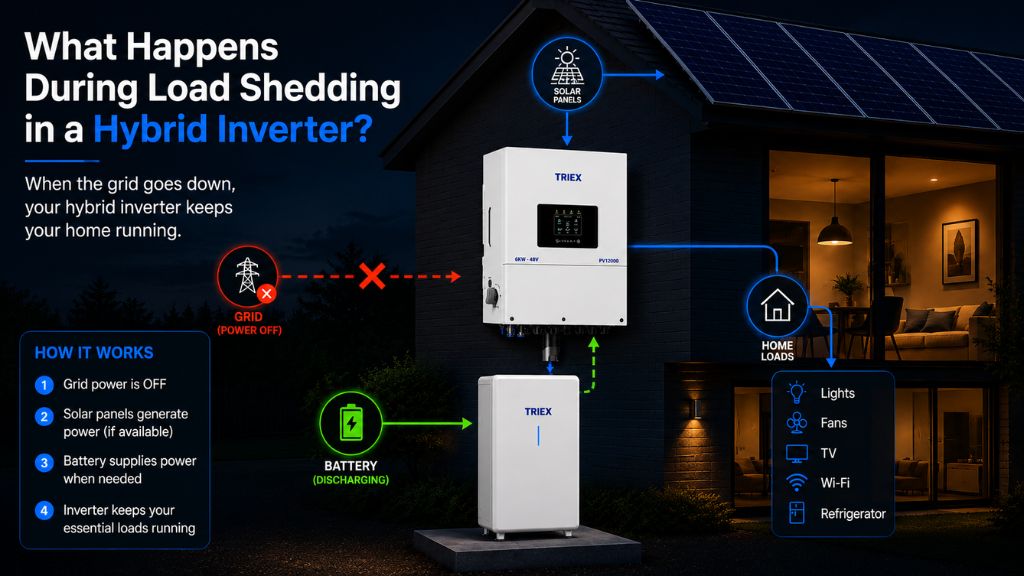
Quick Answer: When load shedding starts, a hybrid inverter detects the grid failure in under 10 milliseconds, disconnects from K-Electric or WAPDA automatically, and switches your home to battery and solar power. In fast models, this switching takes less than 4 milliseconds. Most appliances keep running without any interruption.
If you live in Karachi, Lahore, or anywhere in Pakistan where K-Electric or WAPDA cuts power daily, you already know how disruptive load shedding is. A hybrid solar inverter changes that experience completely. This article explains exactly what happens inside the inverter the moment grid power fails.
What a Hybrid Inverter Does During Normal Operation
A hybrid inverter manages three power sources simultaneously: your solar panels, your battery bank, and the electricity grid. During normal operation it does all of this automatically:
- • Powers your home directly from solar panels during daylight hours
- • Charges the battery bank with any extra solar energy
- • Uses grid power when solar is not enough
- • Exports surplus solar to the grid if you have net metering from K-Electric
All of this happens in real time, many times per second, through internal electronics that continuously monitor voltage, frequency, and your home load.
The Exact Moment Grid Power Fails
When load shedding starts, the grid voltage at your street drops to zero suddenly. In Karachi, K-Electric cuts feeders in rotation for 2 to 4 hours in low-recovery zones. In Punjab and other provinces, WAPDA schedules can reach 4 to 12 hours daily in summer.
The hybrid inverter’s internal sensors detect this failure in under 10 milliseconds, usually much faster. Here is what happens next, in order.
Grid Disconnection
The inverter immediately disconnects from the grid. This is not optional. IEC 62116 and IEC 62109 international safety standards require every certified inverter to stop feeding the grid within a few electrical cycles of a power failure. This protects K-Electric and WAPDA engineers who may be working on the lines during the outage. This function is called anti-islanding protection.
Battery Activation
Once the grid is disconnected, the inverter switches an internal electronic relay, which connects the battery bank to the inverter’s DC terminals. The inverter then draws DC power from the battery and converts it into 230V AC for your home.
This entire switching sequence is pre-programmed and completes in 4 to 20 milliseconds depending on the model.
Solar Continues Supplying Power
If it is daytime, solar panels continue generating throughout the outage. The inverter uses solar to power the home and recharge the battery simultaneously. In Karachi in June, panels delivering 6 to 8 kilowatts can run fans, lights, a refrigerator, and a 1-ton inverter AC while topping up the battery, all without the grid.
What Less Than 4ms Switching Means in Real Life
A switching time of less than 4 milliseconds is faster than one full electrical cycle, which is 20 milliseconds at Pakistan’s 50Hz grid frequency. Here is the real-world impact:
WiFi router and internet:
Routers are designed to tolerate power dips of up to 10 to 20 milliseconds. At less than 4ms, the router never detects an interruption. Your internet stays connected throughout the entire outage. (Solar Victoria, Backup Power Guide)
Computer and office work:
The interruption is shorter than what a computer can register. No restart, no unsaved work lost. The computer continues running normally.
Ceiling fans and lights:
A ceiling fan motor cannot physically decelerate in 4 milliseconds. The fan keeps spinning at the same speed with zero flicker.
Refrigerator:
The compressor does not restart. Frequent compressor restarts under load cause early failure. Fast switching means continuous power and longer appliance life.
If switching time were 100ms or more, lights would visibly blink, computers would restart, and routers would drop.
Pakistan-Specific Context
In Karachi, K-Electric feeders often deliver unstable voltage with frequent flickers and short outages in addition to scheduled load shedding. In Punjab and Khyber Pakhtunkhwa, WAPDA cuts can reach 4 to 12 hours daily on high-loss feeders in summer.
For these conditions, a hybrid inverter that meets IEC 62109 for safety of power converters and follows IEC 60364-7-712 for PV installation wiring is strongly recommended. These standards cover protection against shocks, fires, and overloads, which is critical when dealing with Pakistan’s fluctuating grid and frequent islanding cycles.
Frequently Asked Questions
Does a hybrid inverter work during load shedding without solar panels?
Yes. The inverter draws from the battery regardless of whether solar is producing. Solar simply recharges the battery faster when available.
What IEC standards should a hybrid inverter meet for Pakistan?
At minimum: IEC 62109-1 and IEC 62109-2 for electrical safety, IEC 62116 for anti-islanding protection, and IEC 61727 for grid connection. These are the standards referenced by NEPRA for net metering approvals in Pakistan.
Does the inverter switch back to grid automatically when power returns?
Yes. The inverter detects the returning voltage and frequency, verifies stability for a few seconds, then reconnects automatically. No manual action needed.
What is anti-islanding protection?
A mandatory safety feature required by IEC 62116. It disconnects the inverter from the grid within milliseconds of a power failure, preventing electricity from flowing back into dead lines where utility workers may be present.
Is less than 4ms switching better than 20ms?
Yes, significantly. At 4ms, routers, computers, and fans experience zero interruption. At 20ms, sensitive electronics may briefly flicker or reset. For Pakistani homes with multiple daily outages, 4ms switching makes load shedding genuinely unnoticeable.