
Table of Contents
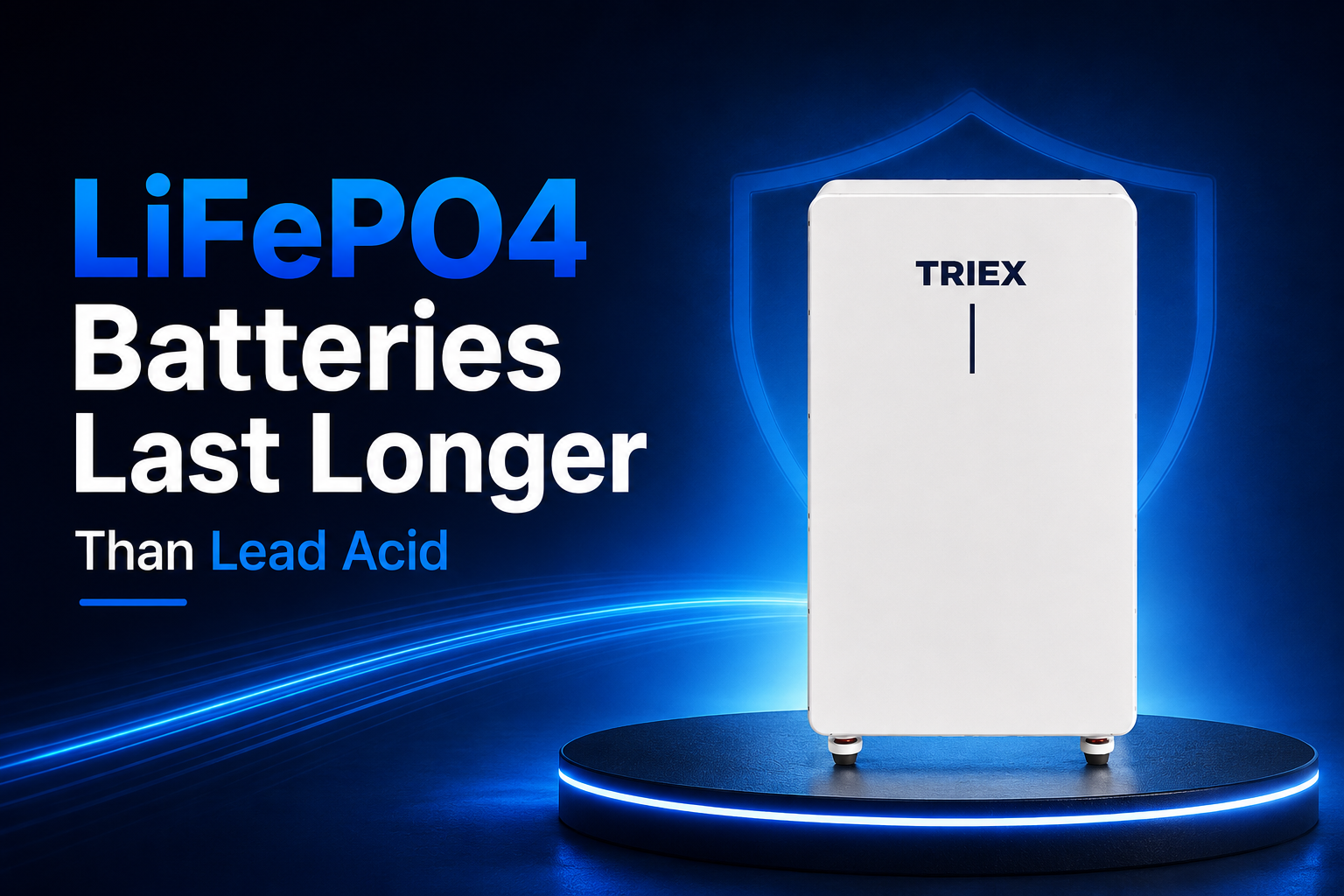
Quick Answer: LiFePO4 batteries last 10 to 15 years in Pakistani conditions because they handle daily deep discharge, high heat, and frequent load shedding cycles without rapid degradation. Lead-acid batteries under the same conditions typically need replacement every 2 to 4 years. Over a 10-year period, LiFePO4 often costs the same or less in total.
In Pakistani homes with hybrid solar systems, the battery is almost always the first thing to fail. Many people focus on the inverter and panels, but the real long-term cost comes from how often you replace the battery. This article explains exactly why LiFePO4 batteries outlast lead-acid in Pakistan’s specific conditions.
What a LiFePO4 Battery Is
LiFePO4 stands for lithium iron phosphate. It is a type of lithium battery where the cathode material is made from iron and phosphate instead of more reactive materials like cobalt.
For a homeowner, this chemistry means two practical things. First, it tolerates deep daily discharge without losing capacity quickly. Second, it is thermally stable, meaning it does not overheat easily and handles Pakistan’s high ambient temperatures better than most alternatives.
Every LiFePO4 battery includes a built-in Battery Management System, which monitors charging, discharging, temperature, and individual cell voltages automatically. You do not need to manage any of this manually.
How Battery Cycles Work
A charge cycle is one complete charge and discharge. Charging from 20% to 100% and then discharging back to 20% counts as one full cycle. If you only use 50% of the battery capacity each day, it takes two days to complete one cycle.
Battery lifespan is measured in how many cycles the battery can complete before its capacity drops below a usable level.
Battery Type | Cycle Life at 80% Depth of Discharge | Typical Lifespan in Pakistan |
Flooded lead-acid | 500 to 1,000 cycles | 2 to 4 years |
AGM or Gel lead-acid | 800 to 1,500 cycles | 3 to 5 years |
LiFePO4 | 4,000 to 8,000 cycles | 10 to 15 years |
In Pakistan, homes with daily load shedding complete 1 to 2 full cycles per day in summer. At that rate, a quality lead-acid battery reaches its end of life in 3 to 5 years. A LiFePO4 battery under the same conditions lasts 10 to 15 years before needing replacement.
Why Pakistani Conditions Are Harder on Batteries
Depth of Discharge
Lead-acid batteries should ideally be discharged to only 40 to 50% of their capacity. Regularly going deeper than that cuts the lifespan significantly. In a Pakistani home running fans, lights, a refrigerator, and sometimes an AC through an 8-hour outage, the battery is often discharged to 70 to 80% or more every single night.
LiFePO4 batteries can safely discharge to 80 to 90% of their capacity daily without accelerating degradation. This means for the same load pattern, a LiFePO4 battery survives in conditions that would exhaust a lead-acid bank in a fraction of the time.
Heat
Lead-acid batteries are sensitive to heat. Temperatures above 40 degrees Celsius increase internal corrosion and accelerate capacity loss. On a Karachi rooftop in summer, battery cabinet temperatures regularly reach 45 to 50 degrees Celsius. A lead-acid bank in these conditions can lose half its usable capacity within 3 to 4 years.
LiFePO4 has an operating range of approximately -20 to +60 degrees Celsius, with the optimal window between 0 and 45 degrees. The built-in BMS automatically limits charging and discharging beyond safe temperature thresholds, protecting the cells from heat damage.
Load Shedding Patterns
The typical Pakistani household load-shedding pattern is particularly hard on lead-acid batteries. Load shedding often starts in the evening, the battery runs through the night on fans, lights, and a refrigerator, and the grid returns for only a few hours before the next outage. This means shallow recharging followed by another deep discharge, repeated daily for months.
LiFePO4 batteries charge at 95 to 98% efficiency. Even a 2 to 4 hour grid window is enough to fully recharge a LiFePO4 battery. Lead-acid batteries charge less efficiently and need longer grid windows to recover fully, which many Pakistani homes simply do not have during peak summer load shedding.
While battery capacity determines how long your backup lasts, switching speed determines how smoothly your home transitions from grid power to battery power during an outage. Understanding less than 4ms switching time helps homeowners evaluate the complete backup experience instead of focusing only on battery capacity.
Real Replacement Cost Over 10 Years
LiFePO4 batteries cost more upfront. But the total cost over 10 years tells a different story.
Battery Type | Approximate Price (PKR) | Typical Lifespan | Cost Over 10 Years |
Flooded lead-acid | 15,000 to 25,000 | 2 to 4 years | 75,000 to 120,000 |
AGM or Gel lead-acid | 25,000 to 35,000 | 3 to 5 years | 75,000 to 120,000 |
LiFePO4 | 85,000 to 110,000 | 8 to 12 years | 85,000 to 110,000 |
Over 10 years, a typical Pakistani household replaces lead-acid batteries 2 to 4 times, each time paying for the battery and installation labor. A LiFePO4 battery in the same period may need no replacement at all, or at most one.
The upfront price difference effectively disappears when you account for repeat purchases, installation costs, and the disruption of replacing a battery every few years.
Maintenance Differences
Lead-Acid Maintenance Requirements
Flooded lead-acid batteries need regular topping up with distilled water, periodic equalization charges, and proper ventilation because they release hydrogen gas during charging. AGM and gel types are maintenance-free but still require correct charging profiles and protection from heat and over-discharge.
In practice, most Pakistani homeowners do not perform these maintenance steps consistently, which is one reason lead-acid batteries in real-world use fail even earlier than their rated cycle life suggests.
LiFePO4 Maintenance Requirements
LiFePO4 batteries require almost no user maintenance. There is no water to top up, no equalization needed, and no individual cell checks required. The built-in BMS handles overcharge protection, over-discharge cutoff, short circuit protection, and temperature management automatically.
This makes LiFePO4 significantly more suitable for Pakistani homes where regular battery maintenance is not practical.
Frequently Asked Questions
Is LiFePO4 worth the higher upfront cost in Pakistan?
Yes, for most homes with daily load shedding. When you calculate total replacement cost over 10 years, LiFePO4 often costs the same or less than replacing lead-acid batteries multiple times. The longer the load shedding pattern continues, the stronger the case for LiFePO4.
Can LiFePO4 batteries handle Karachi's heat?
Yes, better than lead-acid. LiFePO4 has a wider safe operating temperature range and a built-in BMS that limits operation beyond safe thresholds. Lead-acid batteries lose capacity much faster above 40 degrees Celsius.
How deep can I discharge a LiFePO4 battery daily?
Up to 80 to 90% depth of discharge daily without significantly shortening the lifespan. This is a major advantage over lead-acid, which should ideally not exceed 50% discharge to maintain rated cycle life.
Do LiFePO4 batteries need special chargers or inverters?
The inverter must support lithium battery profiles and ideally communicate with the battery's BMS through CAN or RS485. Most quality hybrid inverters support this. Always confirm compatibility before purchasing.
What happens if I install a LiFePO4 battery in a hot location?
The BMS will limit or stop charging and discharging if temperature exceeds safe limits. The battery protects itself automatically. However, consistently operating near the upper temperature limit does reduce long-term cycle life, so keeping the battery in a shaded, ventilated location is always better.