
Table of Contents
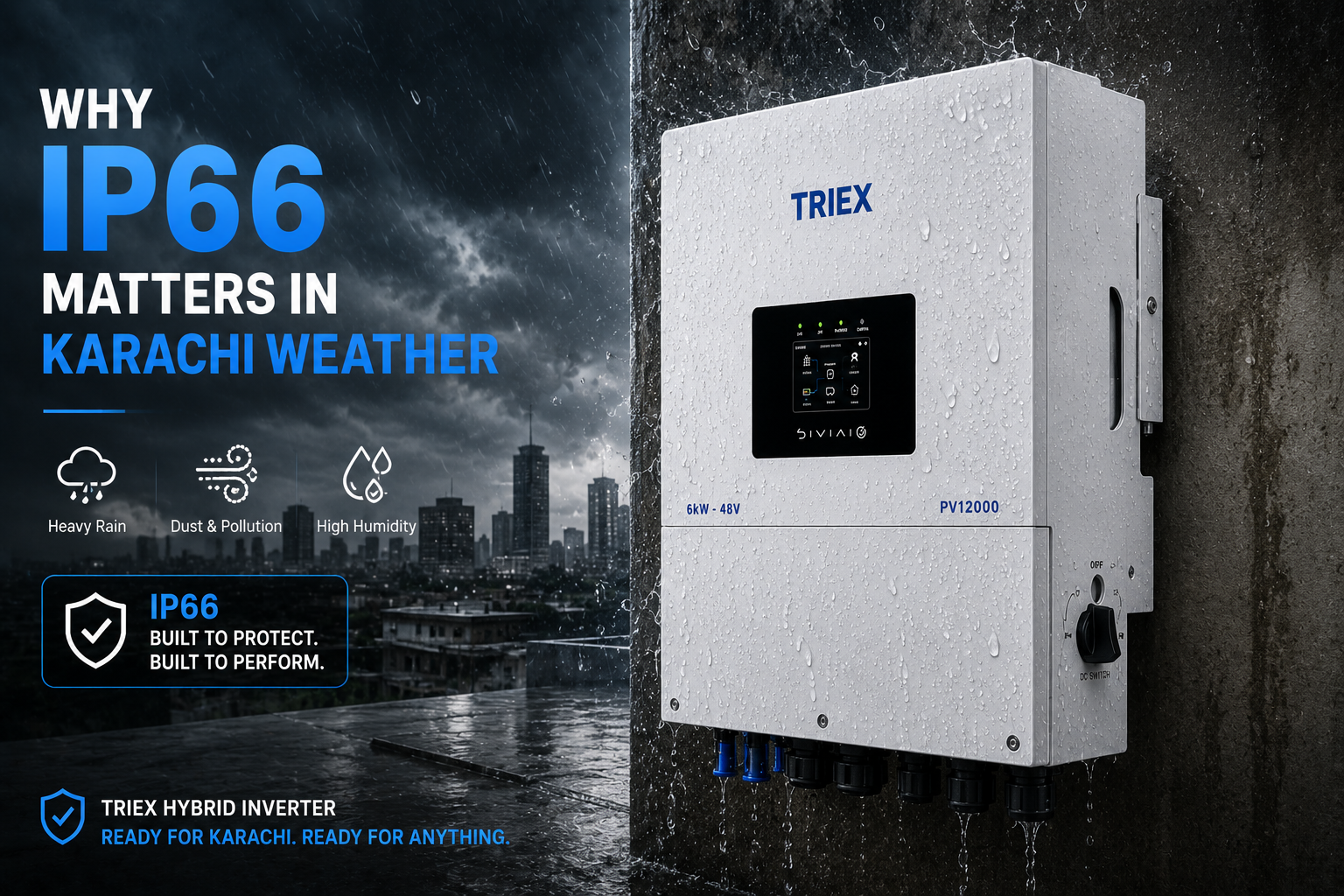
Quick Answer: IP66 means an inverter is completely dustproof and can handle powerful water jets from any direction. In Karachi’s humidity, monsoon rain, salt air, and rooftop heat, an IP66-rated inverter lasts 10 to 15 years outdoors. An IP21 indoor inverter in the same conditions typically starts failing within 2 to 3 years.
If you are planning a rooftop solar installation in Karachi, the inverter’s IP rating is not a technical detail to ignore. It directly determines how long your inverter survives in Pakistan’s most demanding coastal climate.
What IP66 Actually Means
IP stands for Ingress Protection, defined by the IEC 60529 international standard. The rating has two digits.
The first digit goes from 0 to 6 and measures protection against solid objects and dust. The second digit goes from 0 to 9 and measures protection against water.
For IP66 specifically:
- ● The first 6 means completely dustproof. No dust enters the enclosure under any conditions.
- ● The second 6 means protection against powerful water jets from any direction, including heavy monsoon rain and direct hose exposure.
An IP21 rating, which is common on indoor inverters, means protection only against objects larger than 12mm and against vertically dripping water. It offers no protection against rain, dust, or humidity.
How Karachi's Climate Attacks Inverters
Karachi combines three specific conditions that destroy unprotected electronics faster than almost any other city in Pakistan. These environmental conditions become even more challenging during frequent power outages when the inverter must switch between the grid and the battery multiple times each day.
Humidity and Salt Air
Karachi is a coastal city. Humidity stays high year-round, and in areas close to the sea, the air carries salt particles. Over time, this combination forms a thin conductive film on circuit boards and internal terminals. This film causes corrosion and can create short circuits.
In rooftop installations just a few kilometers from the sea, inverters with inadequate IP ratings develop rusted terminals inside the cabinet within 2 to 3 years, even when the outer casing looks perfectly fine from the outside.
Monsoon Rain and Standing Water
During the monsoon season, Karachi rooftops regularly experience heavy sideways rain and standing water. An IP21 inverter is designed only for vertically dripping water. Even a small gap around cable entries is enough for monsoon rain to seep inside and damage the internal components.
An IP66 enclosure is specifically tested against powerful water jets from any direction. Combined with properly sealed cable entries, it handles Karachi’s monsoon conditions without any water ingress.
Rooftop Dust and Heat
Karachi rooftops collect dust, construction particles, and smog continuously. When dust enters an inverter, it mixes with humidity and forms a sludge that can short-circuit components and block cooling fins. A blocked cooling fin raises the internal operating temperature significantly.
On a 42 degree Celsius summer day, a Karachi rooftop surface can reach 48 to 52 degrees. An inverter that is already heat-soaked and clogged with dust runs even hotter and fails much earlier than its rated lifespan.
IP66 vs IP21 in Real Karachi Installations
Type | Location | Protection | Suitable For |
IP21 | Indoors only | Large objects and vertical drips only | Clean, dry, ventilated meter rooms |
IP66 | Outdoors or exposed areas | Completely dustproof, powerful water jets | Rooftops, balconies, coastal zones |
In practice, IP21 inverters work correctly when installed in a clean, dry, ventilated utility room away from the roof. The problem is that in many Karachi homes, space is limited, and installers end up mounting IP21 units directly on open rooftops or exposed balconies under a small metal shade. This is where failures start.
In installations across Clifton, DHA, and North Nazimabad, IP21 inverters installed on open rooftops showed internal condensation, dust buildup, and corrosion within 2 to 3 years. IP66 units mounted on the same rooftops in similar conditions were still clean and fully functional when opened for inspection after 4 years.
Practical Installation Tips for Pakistani Homes
These points come from real installation experience across Karachi. They are not written in any product manual.
Choose location before choosing inverter. If you can install indoors in a dry, ventilated room, IP21 is acceptable. If the inverter must go on a rooftop or open balcony, IP66 is not optional, it is the minimum requirement.
Leave clearance on all sides. Mount the inverter on a solid wall with at least 10 to 15 centimeters of clear space on all sides. This allows heat to escape naturally. Never mount the inverter directly against the wall with no airflow gap.
Avoid metal roof overhangs that trap heat. A metal shed directly above the inverter traps hot air and raises the operating temperature. Mount on a side wall with open air circulation instead.
Use proper cable glands on every entry point. Installation safety is just as important as environmental protection, especially when connecting lithium batteries and DC wiring. All AC and DC cable entries must be sealed with proper cable glands and sealing rings. Loose cable entries are the most common point of moisture and dust ingress, even on IP66 units.
Seal all unused ports. Any unused PV input or communication port must be capped with dummy plugs or sealed with appropriate sealant. Insects, moisture, and dust enter through open ports over time.
Raise the inverter above roof flood level. During heavy monsoon, some Karachi rooftops accumulate standing water. Even an IP66 inverter should be mounted on a raised bracket so it never sits directly in pooled water.
Use corrosion-resistant mounting brackets. Salt air accelerates rust on untreated metal. Use stainless steel brackets or mild steel with proper anti-corrosion coating for all rooftop mounting hardware.
Frequently Asked Questions
Is IP65 sufficient or do I need IP66?
IP65 protects against dust and low-pressure water jets. IP66 adds protection against high-pressure water jets. For Karachi's monsoon conditions and coastal humidity, IP66 provides a meaningful extra level of protection.
Does IP66 mean the inverter never needs maintenance?
No. Even IP66 inverters need periodic inspection. Check cable gland seals annually, clean the exterior cooling fins every 3 months, and verify that unused ports remain properly capped.
What standard defines IP ratings?
IEC 60529 is the international standard that defines and tests IP protection levels. When a manufacturer labels a product IP66, it should meet the dust and water test conditions specified in IEC 60529.
What if my inverter is indoors but the room gets dusty?
Even indoors, dust is a problem. Ensure the room has a filtered air vent or is kept reasonably clean. An IP21 inverter in a dusty utility room will accumulate internal dust through its ventilation openings over time.