
Table of Contents
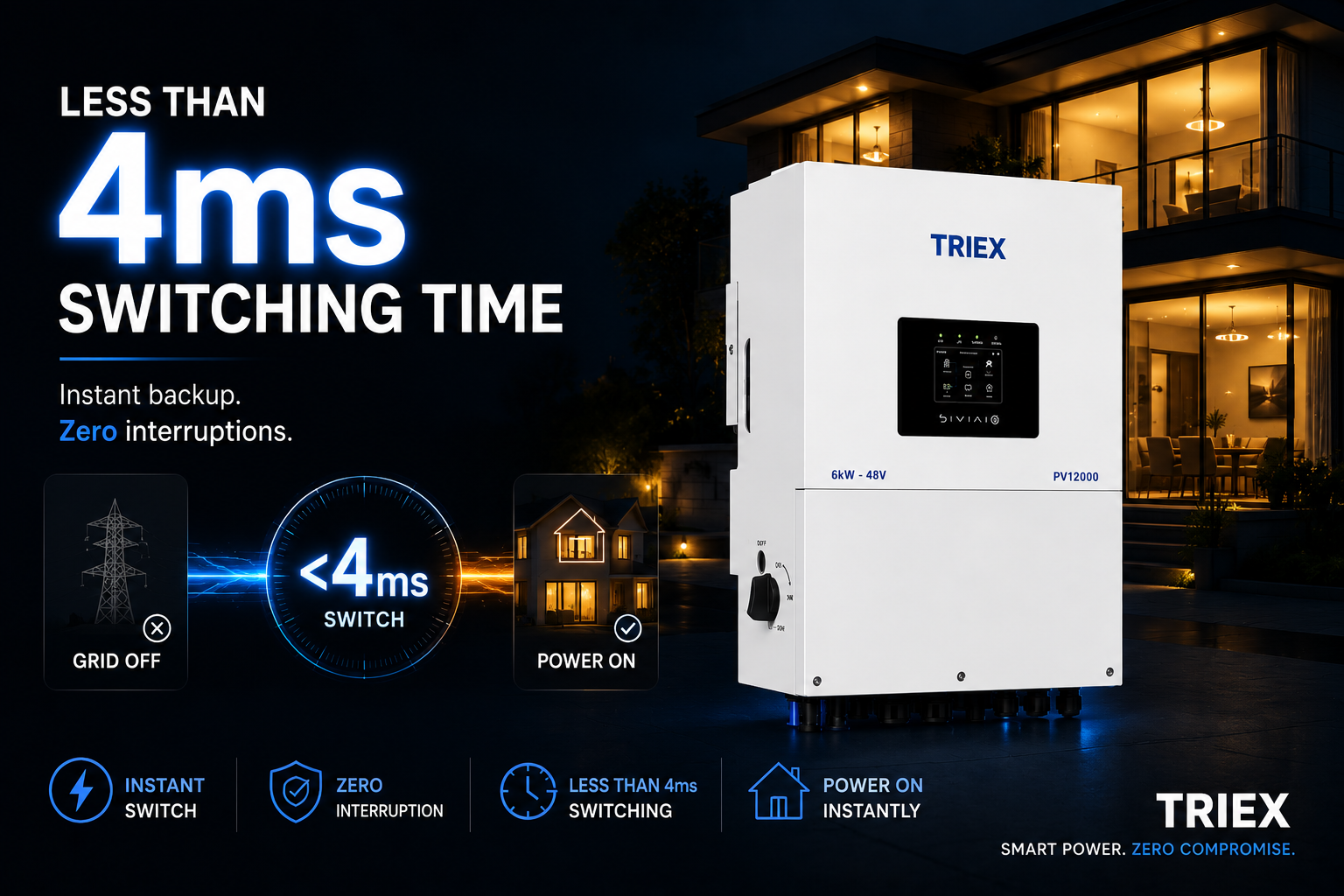
Quick Answer: Switching time is the delay between grid power failing and your inverter starting to feed your home from battery. Less than 4ms means this happens faster than one electrical cycle. Most appliances, routers, and computers never detect that a power cut happened.
If you have been shopping for a hybrid inverter in Pakistan, you have probably seen terms like “seamless backup” or “less than 4ms switching.” But what does this number actually mean for your home in Karachi or Lahore when K-Electric or WAPDA cuts power? To understand why switching time matters, it helps to first understand what actually happens during a power outage in a hybrid inverter system. What Happens During Load Shedding in a Hybrid Inverter in Pakistan?
What Switching Time Actually Is
Switching time is the gap between two moments. First, the moment your grid voltage collapses. Second, the moment your inverter’s output stabilizes at 230V from the battery.
In simple terms, it is how long your home sits without power during the changeover. Manufacturers quote this as milliseconds, typically less than 4ms, around 10ms, or 15 to 20ms. Each of these behaves very differently inside your home.
Why Milliseconds Matter
In Pakistan’s 50Hz electricity system, one full AC cycle takes exactly 20 milliseconds. Most modern electronics are designed to ride through brief power dips of a few milliseconds without shutting down.
If your inverter switches in under 10ms, your devices treat the gap as a small glitch, not a full outage. If the pause stretches to 20ms or more, your devices see a complete power loss and react accordingly. Routers restart. Computers reboot. Lights flicker.
4ms vs 10ms vs 20ms: What Each Feels Like
Switching Time | What Happens in Your Home |
Less than 4ms | Routers, computers, and TVs do not restart. Most people never notice the outage. |
Around 10ms | Most computers and lights stay on, but some sensitive equipment may briefly reset. |
More than 20ms | Lights visibly flicker, computers reboot, WiFi drops, and some medical devices lose settings. |
In Pakistan, where load shedding hits multiple times daily in many areas, the difference between 4ms and 20ms is the difference between true seamless backup and a noticeable interruption every single time.
Pakistan-Specific Context
In Karachi, K-Electric feeders often deliver unstable voltage with frequent flickers and short outages in addition to scheduled load shedding. In Punjab and Khyber Pakhtunkhwa, WAPDA cuts can reach 4 to 12 hours daily on high-loss feeders in summer.
For these conditions, a hybrid inverter that meets IEC 62109 for safety of power converters and follows IEC 60364-7-712 for PV installation wiring is strongly recommended. These standards cover protection against shocks, fires, and overloads, which is critical when dealing with Pakistan’s fluctuating grid and frequent islanding cycles.
What Happens to Your Specific Devices
Routers and WiFi
A less than 4ms inverter restores power before your router’s internal capacitors can drain. The router never enters its restart sequence. Your internet connection stays active, your phone stays connected, and any active downloads continue without interruption.
Computers and Laptops
Your computer’s power supply unit sees a continuous voltage input. There is no shutdown trigger, no blue screen, no lost work. With 10 to 20ms switching, older computers or budget power supplies may briefly brown out and restart, which is a real problem in home offices and small businesses across Karachi and Lahore.
Gaming and Streaming
A gaming console mid-session or a smart TV streaming a show will continue without any break at less than 4ms. At 20ms, the brief power gap is long enough to trigger a restart or disconnect from the online server.
Medical Equipment
This is where switching time becomes genuinely critical. CPAP machines, oxygen concentrators, and monitoring devices used in home clinics are designed to operate with UPS-level backup. At less than 4ms, these devices stay online exactly as they would on a proper UPS. At 20ms or more, some devices can lose settings, disconnect, or interrupt an active function.
Why Many Pakistani Families Do Not Notice Load Shedding
In homes with fast-switching hybrid inverters, a common experience is noticing that the neighbor’s house went dark while yours stayed completely normal. This happens because the inverter’s internal relay switches from grid to battery so quickly that the AC waveform is restored before lights can flicker or motors can slow down.
Older inverters and generators typically have switching delays of 50 to 100ms or more. That delay is exactly why you hear the relay click and see the lights blink with traditional backup systems.
One Important Thing to Verify Before Buying
Not all inverters deliver what their spec sheet claims. Some models advertise less than 4ms switching times but show 20 to 50ms in real-world conditions due to additional software checks under heavy load. Always ask your installer for real-world test data, not just the datasheet figure. Beyond switching speed, installation safety features should also be reviewed before selecting a hybrid inverter.
For homes with computers, home offices, or any medical equipment, target a documented switching time of less than 10ms at minimum, and less than 4ms if possible. When comparing switching speed, battery compatibility, and backup performance, it is important to evaluate the entire hybrid inverter system rather than a single specification. For basic home loads like fans, lights, and a refrigerator, 10 to 20ms is acceptable.
Frequently Asked Questions
Is less than 4ms switching the same as a UPS?
In terms of how your devices experience the transition, yes. A quality UPS also switches in under 4ms. A hybrid inverter with the same spec delivers the same seamless experience, with the added benefit of solar charging and much larger battery capacity.
Does switching time affect my electricity bill?
No. Switching time only affects how smooth the transition feels during load shedding. It has no impact on energy efficiency or electricity consumption.
Will a 10ms inverter damage my appliances?
No, it will not damage appliances. But sensitive devices like computers and routers may restart during each outage, which is inconvenient and can cause data loss in a home office setting.
Does switching time matter if I have a generator?
Yes. Generators typically take 5 to 30 seconds to start and stabilize. During that gap, your home has no power. A hybrid inverter with less than 4ms switching eliminates that gap entirely.
Do all hybrid inverters have the same switching time?
No. Switching time varies significantly between brands and models. Always check the specification sheet and confirm with your installer whether the quoted figure applies under full load conditions.