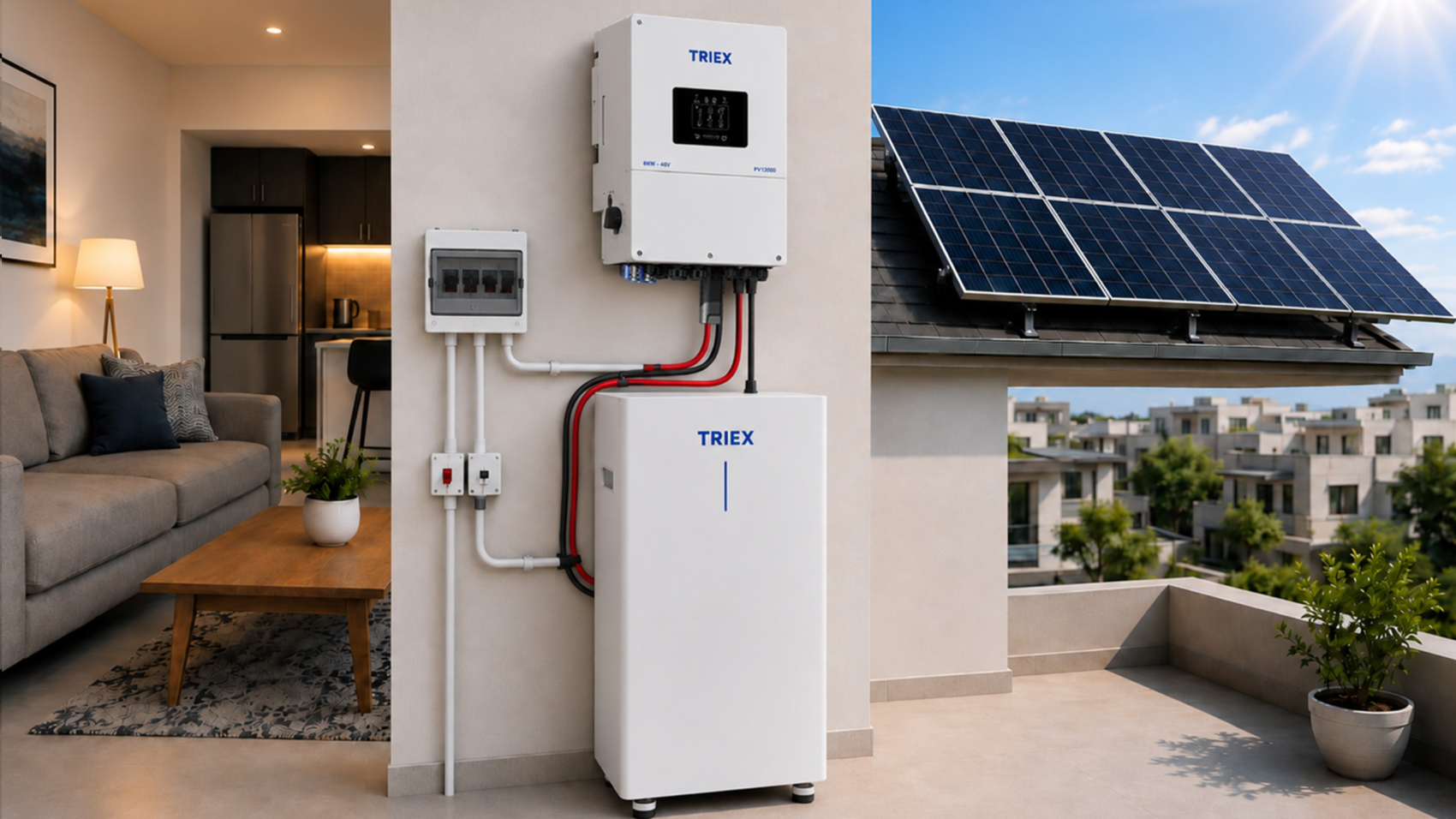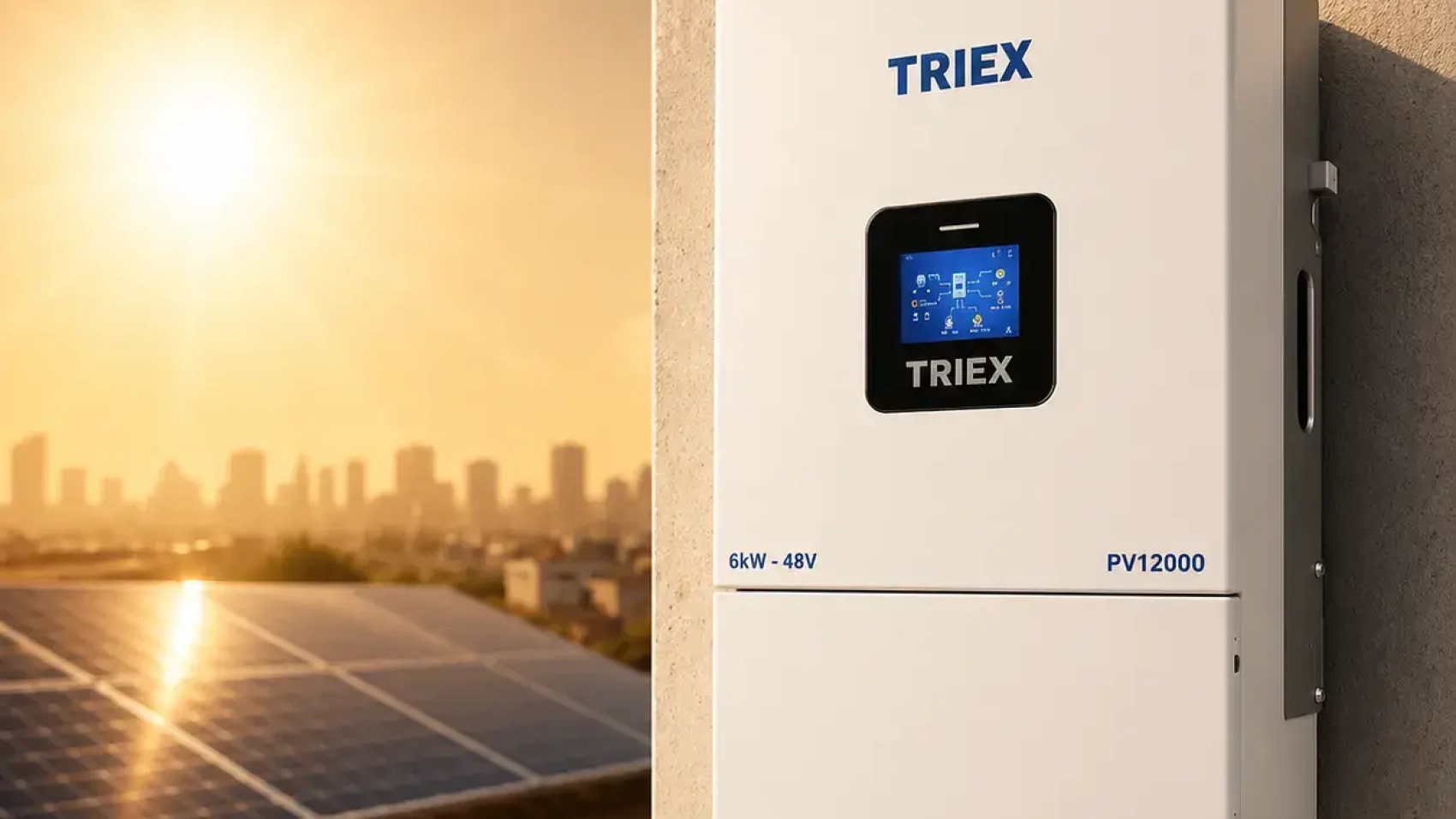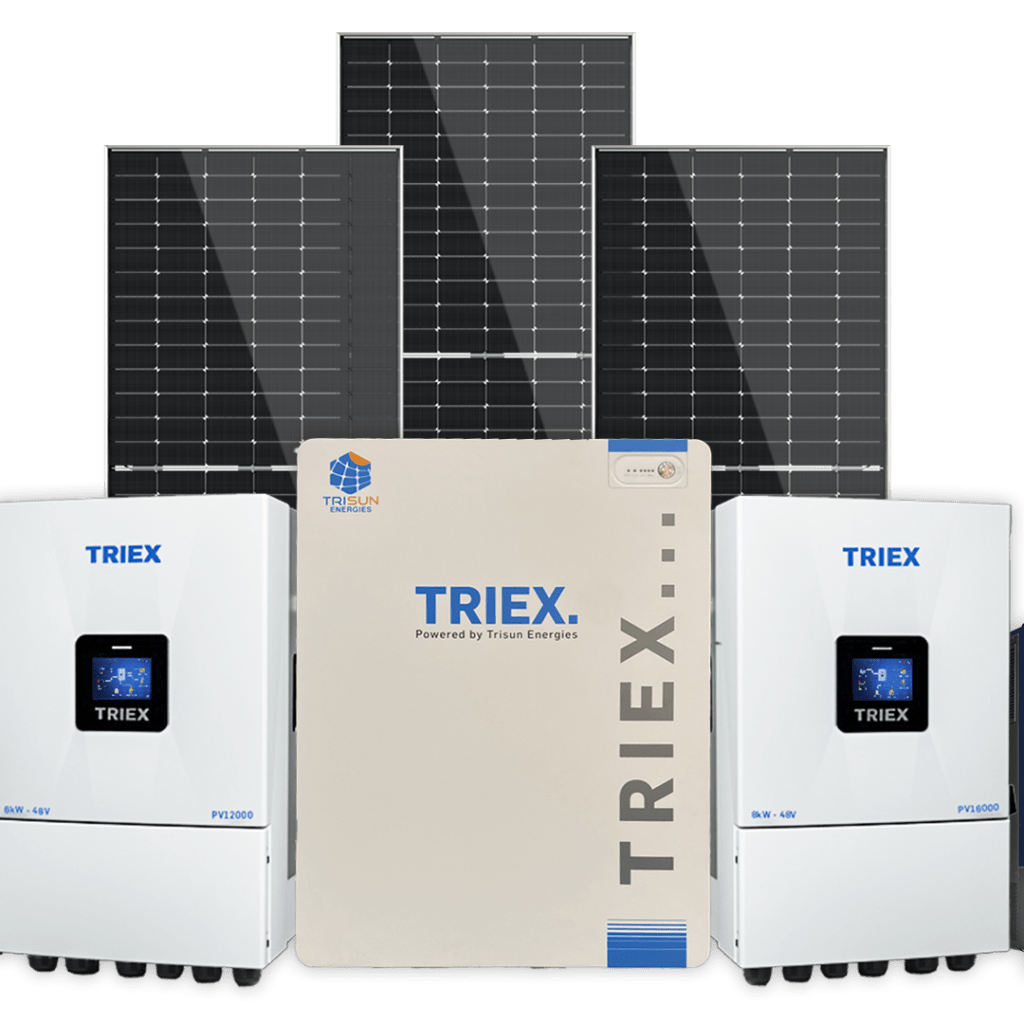

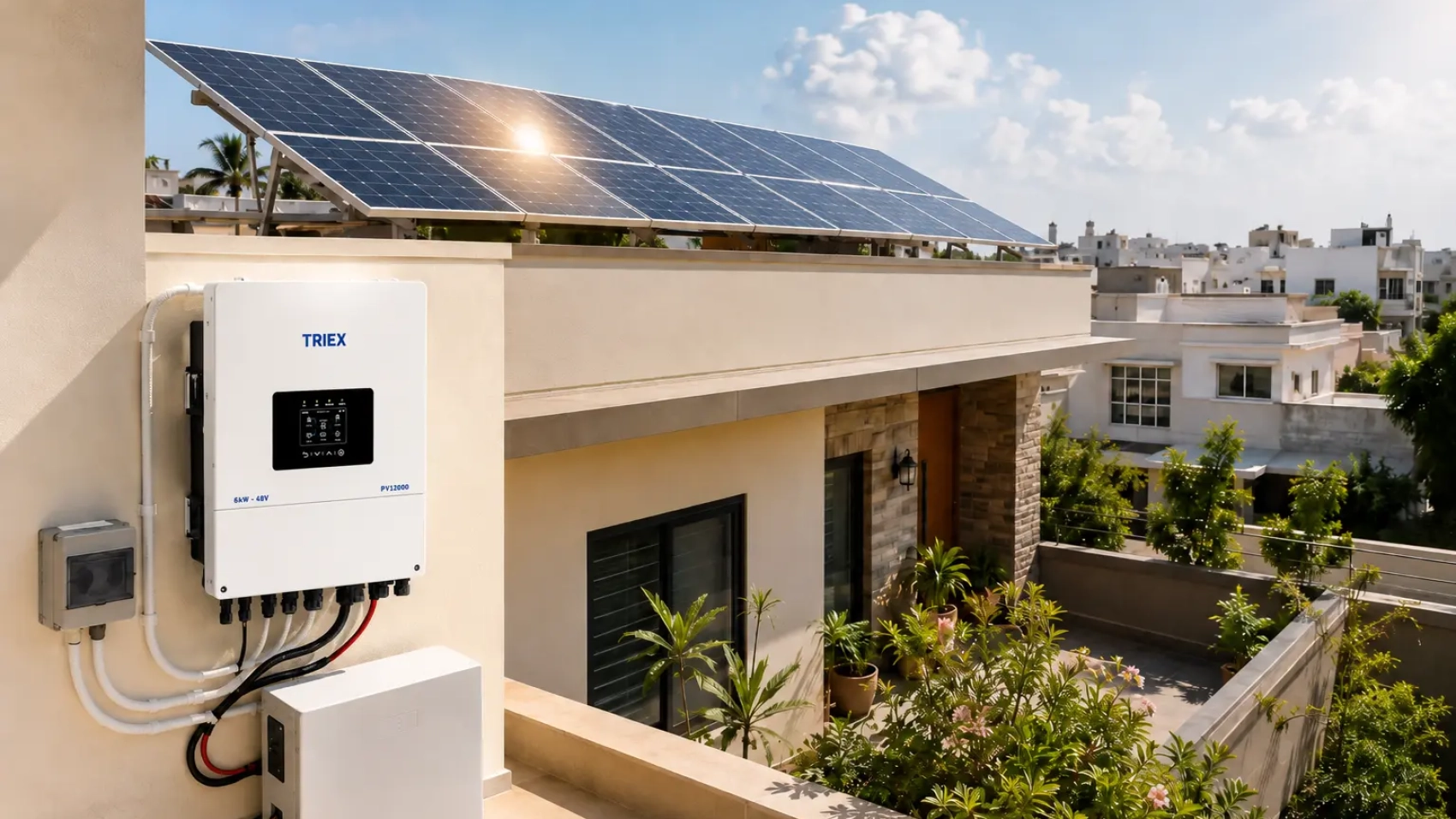
hybrid solar inverter switching to battery during load shedding in Pakistan

What Happens During Load Shedding in a Hybrid Inverter in Pakistan?

Table of Contents

hybrid solar inverter switching to battery during load shedding in Pakistan

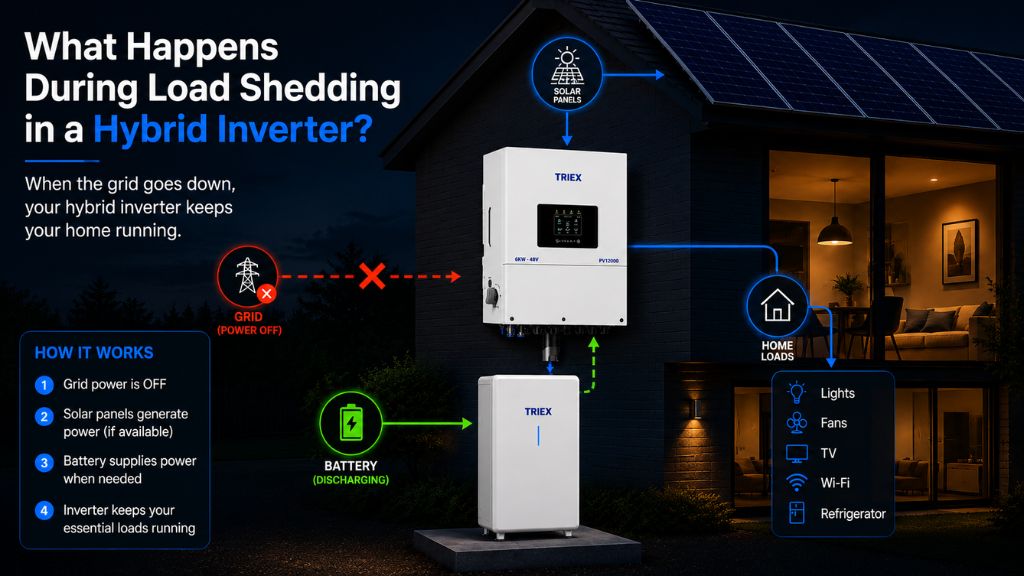
Quick Answer: When load shedding starts, a hybrid inverter detects the grid failure in under 10 milliseconds, disconnects from K-Electric or WAPDA automatically, and switches your home to battery and solar power. In fast models, this switching takes less than 4 milliseconds. Most appliances keep running without any interruption.

If you live in Karachi, Lahore, or anywhere in Pakistan where K-Electric or WAPDA cuts power daily, you already know how disruptive load shedding is. A hybrid solar inverter changes that experience completely. This article explains exactly what happens inside the inverter the moment grid power fails.

What a Hybrid Inverter Does During Normal Operation

A hybrid inverter manages three power sources simultaneously: your solar panels, your battery bank, and the electricity grid. During normal operation it does all of this automatically:

  • • Powers your home directly from solar panels during daylight hours
  • • Charges the battery bank with any extra solar energy
  • • Uses grid power when solar is not enough
  • • Exports surplus solar to the grid if you have net metering from K-Electric

All of this happens in real time, many times per second, through internal electronics that continuously monitor voltage, frequency, and your home load.

The Exact Moment Grid Power Fails

When load shedding starts, the grid voltage at your street drops to zero suddenly. In Karachi, K-Electric cuts feeders in rotation for 2 to 4 hours in low-recovery zones. In Punjab and other provinces, WAPDA schedules can reach 4 to 12 hours daily in summer. 

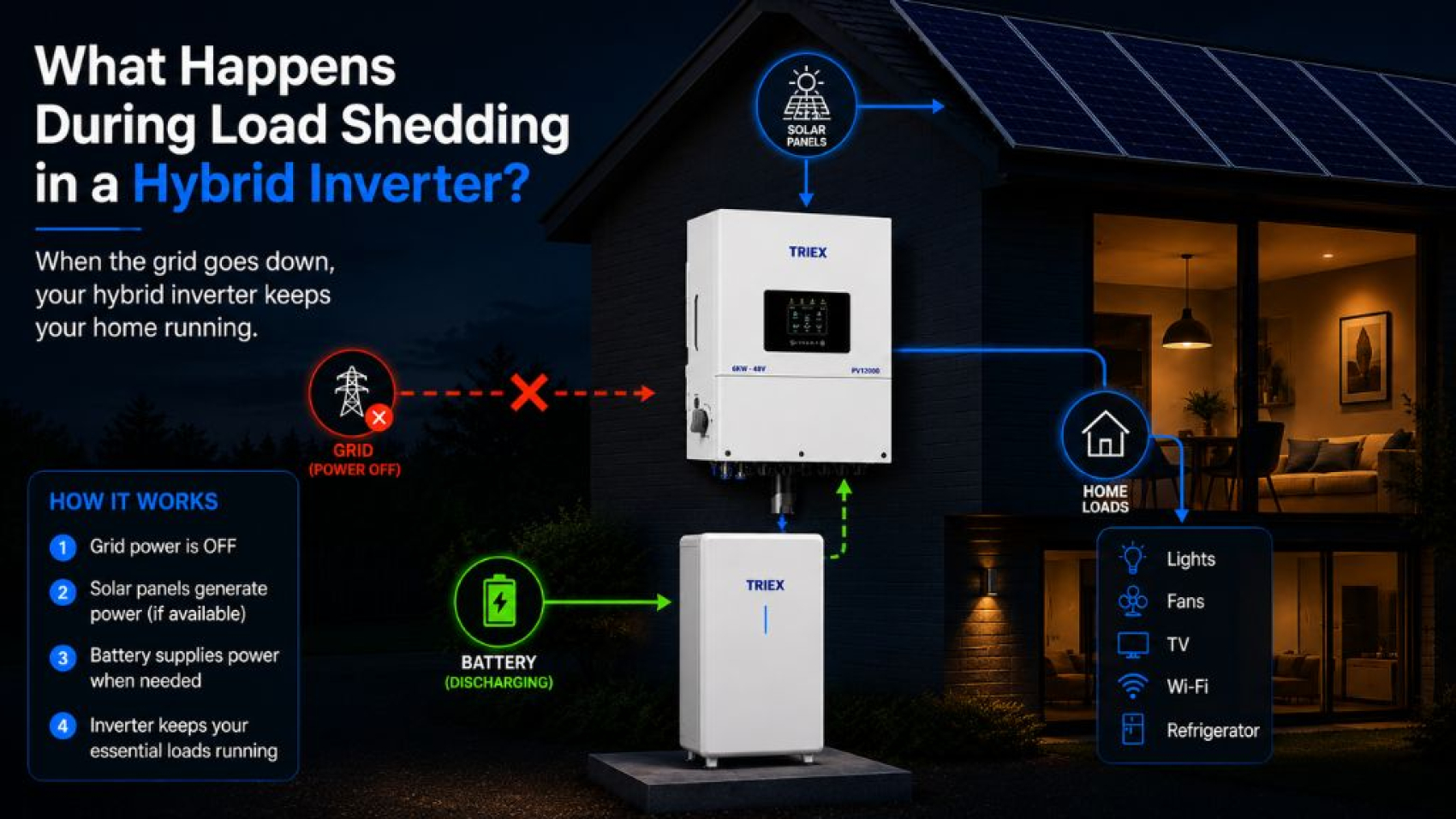
The hybrid inverter’s internal sensors detect this failure in under 10 milliseconds, usually much faster. Here is what happens next, in order.

Grid Disconnection

The inverter immediately disconnects from the grid. This is not optional. IEC 62116 and IEC 62109 international safety standards require every certified inverter to stop feeding the grid within a few electrical cycles of a power failure. This protects K-Electric and WAPDA engineers who may be working on the lines during the outage. This function is called anti-islanding protection. 

Battery Activation

Once the grid is disconnected, the inverter switches an internal electronic relay, which connects the battery bank to the inverter’s DC terminals. The inverter then draws DC power from the battery and converts it into 230V AC for your home.

This entire switching sequence is pre-programmed and completes in 4 to 20 milliseconds depending on the model. 

Solar Continues Supplying Power

If it is daytime, solar panels continue generating throughout the outage. The inverter uses solar to power the home and recharge the battery simultaneously. In Karachi in June, panels delivering 6 to 8 kilowatts can run fans, lights, a refrigerator, and a 1-ton inverter AC while topping up the battery, all without the grid.

What Less Than 4ms Switching Means in Real Life

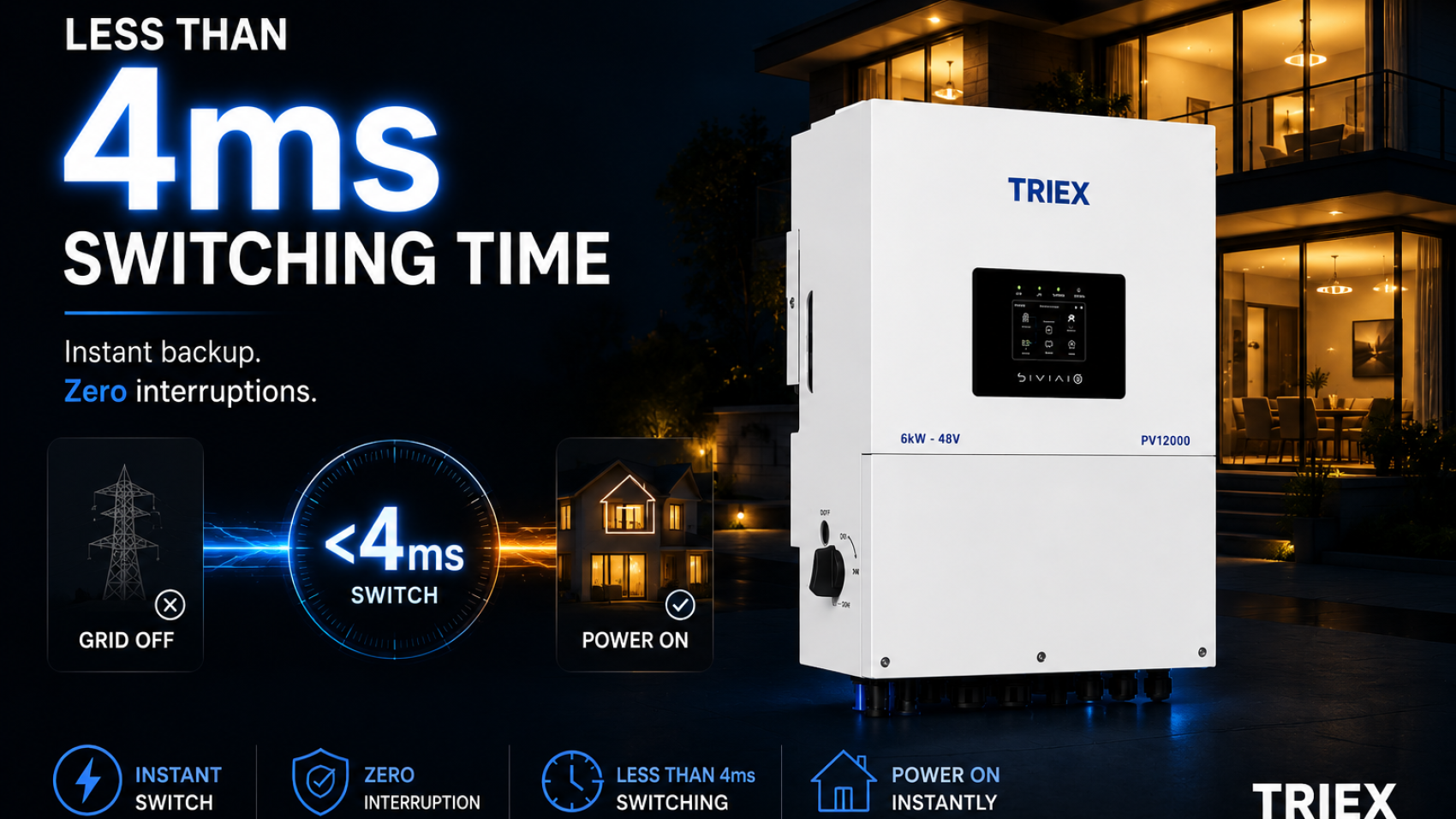
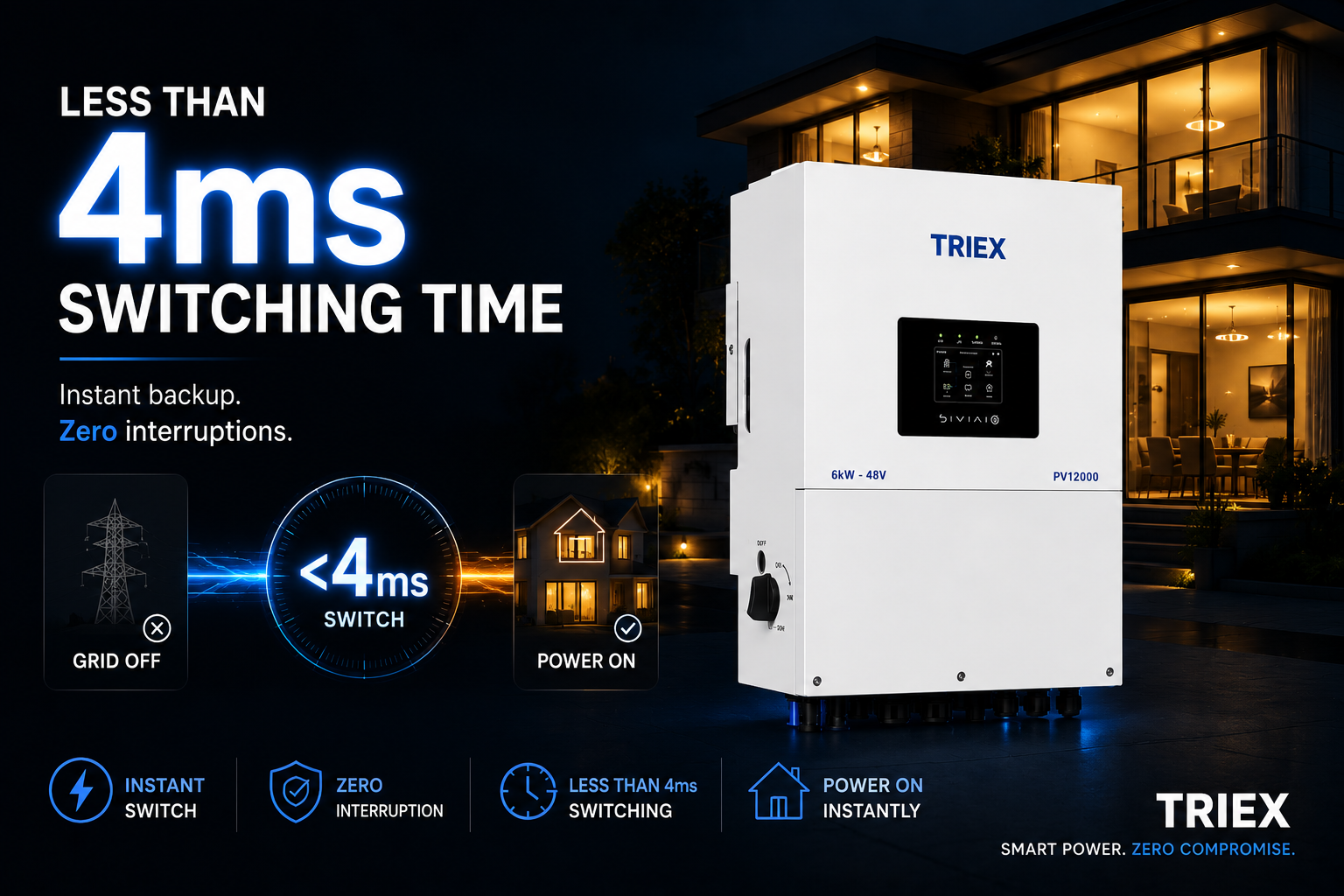
A switching time of less than 4 milliseconds is faster than one full electrical cycle, which is 20 milliseconds at Pakistan’s 50Hz grid frequency. Here is the real-world impact:

WiFi router and internet:

Routers are designed to tolerate power dips of up to 10 to 20 milliseconds. At less than 4ms, the router never detects an interruption. Your internet stays connected throughout the entire outage. (Solar Victoria, Backup Power Guide)

Computer and office work:

The interruption is shorter than what a computer can register. No restart, no unsaved work lost. The computer continues running normally.

Ceiling fans and lights:

A ceiling fan motor cannot physically decelerate in 4 milliseconds. The fan keeps spinning at the same speed with zero flicker.

Refrigerator:

The compressor does not restart. Frequent compressor restarts under load cause early failure. Fast switching means continuous power and longer appliance life.

If switching time were 100ms or more, lights would visibly blink, computers would restart, and routers would drop.

Pakistan-Specific Context

In Karachi, K-Electric feeders often deliver unstable voltage with frequent flickers and short outages in addition to scheduled load shedding. In Punjab and Khyber Pakhtunkhwa, WAPDA cuts can reach 4 to 12 hours daily on high-loss feeders in summer.

For these conditions, a hybrid inverter that meets IEC 62109 for safety of power converters and follows IEC 60364-7-712 for PV installation wiring is strongly recommended. These standards cover protection against shocks, fires, and overloads, which is critical when dealing with Pakistan’s fluctuating grid and frequent islanding cycles.

Frequently Asked Questions

Yes. The inverter draws from the battery regardless of whether solar is producing. Solar simply recharges the battery faster when available.

At minimum: IEC 62109-1 and IEC 62109-2 for electrical safety, IEC 62116 for anti-islanding protection, and IEC 61727 for grid connection. These are the standards referenced by NEPRA for net metering approvals in Pakistan.

Yes. The inverter detects the returning voltage and frequency, verifies stability for a few seconds, then reconnects automatically. No manual action needed.

A mandatory safety feature required by IEC 62116. It disconnects the inverter from the grid within milliseconds of a power failure, preventing electricity from flowing back into dead lines where utility workers may be present.

Yes, significantly. At 4ms, routers, computers, and fans experience zero interruption. At 20ms, sensitive electronics may briefly flicker or reset. For Pakistani homes with multiple daily outages, 4ms switching makes load shedding genuinely unnoticeable.

Battery reverse protection safety in hybrid solar inverter installation Pakistan

What Is Battery Reverse Protection and Why It Matters?

Table of Contents

Battery reverse protection safety in hybrid solar inverter installation Pakistan

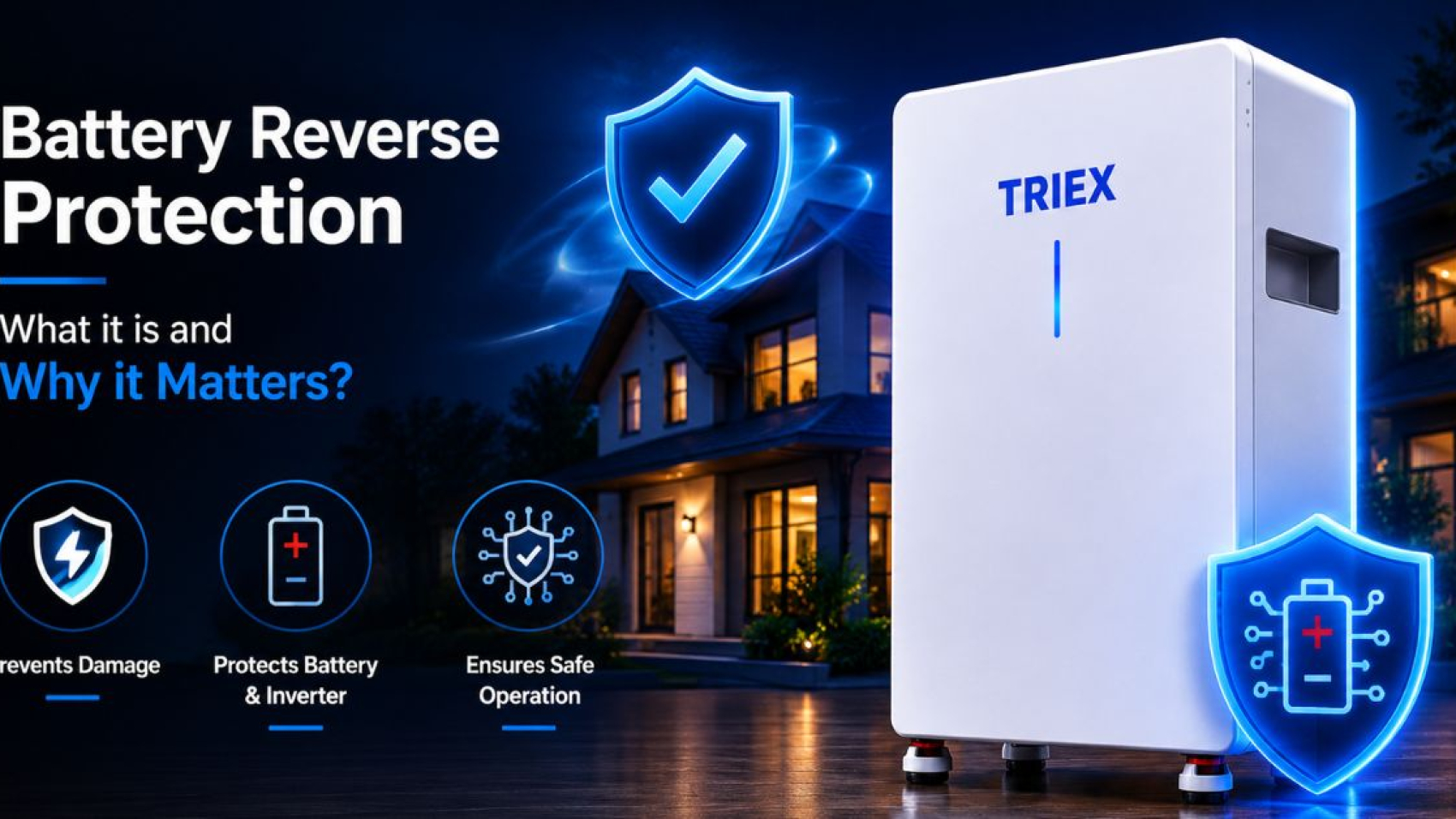
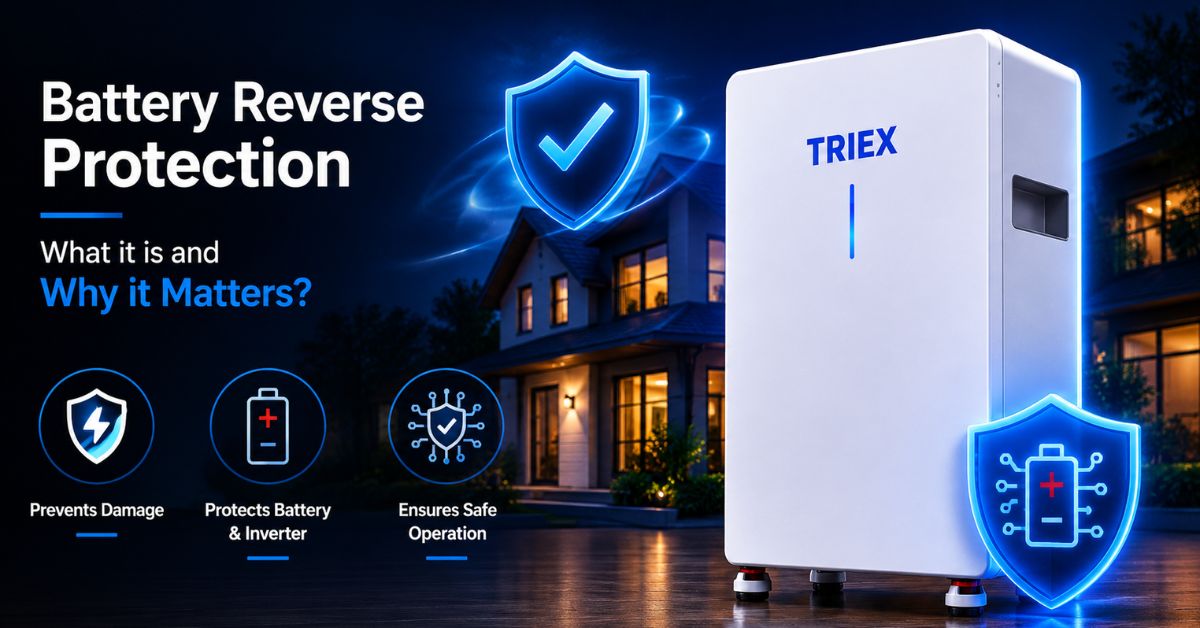
Quick Answer: Battery reverse protection is a safety circuit inside a hybrid inverter that detects when the battery is connected with the wrong polarity and blocks current before it damages the internal components. Without it, a simple wiring mistake can permanently destroy an inverter worth hundreds of thousands of rupees.

In Pakistani homes, one of the easiest and most expensive installation mistakes is connecting the battery to the inverter with positive and negative terminals swapped. This article explains what battery reverse protection is, what happens when it is absent, and how to avoid polarity mistakes during installation. If you are new to solar systems, it also helps to understand how a hybrid solar inverter works before learning advanced installation safety topics.

What Battery Reverse Protection Actually Is

Every battery has two terminals. Positive and negative. Your hybrid inverter also has two battery connection points. Positive and negative. They must match.

Battery reverse protection is a circuit inside the inverter that monitors which direction current is flowing when the battery is first connected. If the battery is connected backwards, meaning positive to negative and negative to positive, this circuit either blocks all current flow or blows an internal fuse before any serious damage can reach the main electronics.

Without this protection, the full current of the battery flows through the inverter’s internal components in the wrong direction the moment the cables are connected.

What Happens When Battery Polarity Is Wrong

If an inverter has weak or no reverse protection and the battery is connected incorrectly, the damage happens in seconds.

A large surge of current forces its way through the inverter’s DC bus and sensitive components in reverse. Internal components including diodes, MOSFETs, and control ICs are not designed to handle reverse current. They burn out almost instantly.

In most cases the inverter shows no display, no startup beep, and no communication with the battery, even though the battery itself is fully charged and undamaged. From the outside the inverter looks fine. Internally the driver circuits and DC bus are permanently destroyed.

On the battery side, if cells are forced into reverse charging, the affected cells can overheat or be permanently damaged.

We have seen this happen multiple times in installations across Karachi and Lahore. The inverter arrives on site, gets connected, and never turns on. The cause in every case was a polarity mistake during cable connection.

Why This Is a Particular Risk in Pakistan

Pakistan’s solar installation market has grown very quickly. Many systems are installed by electricians who have learned on the job without structured solar safety training. On a hot rooftop in Karachi at 40 degrees Celsius, with multiple cables to connect simultaneously, a polarity mistake is easy to make.

IEC 62109, the international safety standard for power converters used in photovoltaic systems, requires inverter designs to include protection against foreseeable installation errors. Battery reverse protection is part of that safety layer.

An inverter with robust reverse protection either blocks the wrong connection entirely or blows a cheap replaceable fuse instead of destroying the main board. An inverter without it transfers the full cost of the mistake to the most expensive component in the system.

Important Disclosure for Triex IP66 Series

The Triex IP66 Hybrid Inverters (6kW and 8kW outdoor series) do not include built-in battery reverse protection. These outdoor rated systems are designed for harsh Pakistani weather conditions and are commonly compared with indoor inverter models during system planning. You can read the complete guide on hybrid solar inverters in Pakistan to understand outdoor vs indoor inverter selection, battery compatibility, and installation planning. This is stated clearly so that installers and homeowners can take the necessary precautions before connecting the battery.

For IP66 installations, the installer must verify correct polarity using a multimeter before making any battery connection. This single step eliminates all risk of reverse polarity damage.

Practical Installation Steps to Prevent Polarity Mistakes

These steps apply to every hybrid inverter installation regardless of brand or model.

Step 1: Label everything before connecting anything. Use red tape or a marker on the positive terminal of both the inverter and the battery. Use black on the negative. Do this before any cables are run. This takes 30 seconds and prevents the most common mistake.

Step 2: Verify with a multimeter before tightening. Place the red probe on the inverter positive battery terminal and the black probe on the inverter negative terminal. Connect the other ends loosely to the battery without tightening. Check the multimeter reading. A positive reading confirms correct polarity. A negative reading means the cables are swapped. Disconnect and swap before proceeding.

Step 3: Connect battery last. Complete all AC output wiring and solar panel connections first. Connect the battery only after everything else is done and double-checked. This reduces the number of steps happening simultaneously and lowers the chance of rushing through the battery connection.

Step 4: Power on and verify communication before connecting the home. Turn the inverter on and confirm it shows correct battery voltage and state of charge on the display or app. Only after this is confirmed should you connect the inverter output to the home distribution board.

Frequently Asked Questions

No. Even with reverse protection, always check polarity before connecting. The protection is a last line of defense, not a substitute for correct installation practice.

Yes, in some configurations. If cells in a multi-battery string are forced into reverse charging, those cells can overheat and suffer permanent capacity loss or physical damage.

Check the inverter's technical specification sheet under protection features. It should explicitly state reverse polarity protection or reverse battery protection. If it is not listed, assume it is not present and take extra precautions during installation. This feature is usually listed in the inverter specifications section alongside protection ratings, switching time, and battery compatibility details.

In most cases the damage to driver circuits and the DC bus is not repairable at a reasonable cost. The inverter is effectively written off and requires full replacement. This makes a 30-second polarity check the most cost-effective step in any installation.

No. Every inverter manufacturer considers reverse polarity connection to be an installation error. Warranty terms universally exclude damage caused by incorrect wiring. Always verify polarity before connecting.

hybrid solar inverter guide for home in Pakistan by Triex

What Is a Hybrid Solar Inverter? Complete Beginner’s Guide

Table of Contents

Quick Definition: A hybrid solar inverter is a single device that connects your solar panels, a battery bank, and the electricity grid all at once, managing all three sources automatically. It keeps your home powered whether the sun is shining, the batteries are charged, or the grid is available.

If you have been searching for a way to beat load shedding without relying on a noisy generator, a hybrid solar inverter is likely the answer you are looking for. Pakistan’s electricity situation, from K-Electric’s unpredictable outages in Karachi to WAPDA’s scheduled cuts across Punjab and Sindh, has pushed millions of homeowners to look for a smarter power solution. This article explains exactly what a hybrid solar inverter is, how it is different from other inverter types, and whether it makes sense for your home. By the end, you will understand the basics clearly enough to make a confident buying decision.

Hybrid solar inverter definition: The one-paragraph answer

A hybrid solar inverter is an all-in-one energy management device. It takes DC electricity from your solar panels, converts it to AC electricity your home can use, charges your battery bank when solar is available, and draws from the grid when neither solar nor batteries are enough. Think of it as a smart traffic controller for electricity. It watches all three lanes of power coming in and decides, in real time, which lane to use and when.

The word “hybrid” refers to this combination. One device handles what older systems needed three separate devices to do.

Why is it called "hybrid"?

The name comes from the fact that it works with multiple power sources at the same time.

Three power sources it manages

A hybrid inverter connects to and manages all three of these simultaneously:

Solar panels produce DC electricity during daylight hours. The inverter’s built-in MPPT (Maximum Power Point Tracking) controller optimises how much power is pulled from the panels at any given moment.

Battery bank stores excess solar energy during the day so you can use it at night or during load shedding. The inverter controls all charging and discharging.

Electricity grid (K-Electric or WAPDA) serves as the backup when solar and battery are both insufficient, and as a destination for excess solar power through net metering.

Solar, battery, and grid working together

The intelligence of the device is in how it coordinates all three. When the sun is strong, the inverter powers your home from solar first, charges the battery with the excess, and if batteries are already full, exports the remainder to the grid. When clouds pass over or night falls, it silently switches to battery. When the battery drops below a set level, it pulls from the grid. The homeowner does not need to do anything. The switching happens automatically, in milliseconds for quality inverters.

How is it different from a regular inverter?

Most Pakistani homes already know the basic inverter or UPS. Here is how the hybrid solar inverter is different.

Hybrid vs standard UPS

A standard UPS (uninterruptible power supply) has one job: switch to battery when the grid goes down, and recharge the battery when the grid comes back. It has no solar input. It cannot reduce your electricity bill. It only provides backup.

A hybrid solar inverter does all of that, plus:

  1. Accepts solar input and converts DC solar power to AC
  2. Prioritises solar over grid to cut your electricity bill every month
  3. Exports surplus power to the grid through NEPRA’s net metering programme
  4. Communicates with your battery’s BMS (Battery Management System) for intelligent charging and health monitoring

The result is not just backup power. It is a full energy management system.

Hybrid vs pure solar inverter

A pure on-grid solar inverter connects only solar panels to the grid. It reduces your bill by selling solar power back to the utility. But it has a critical weakness: it shuts off during load shedding. By law and for safety, on-grid inverters must stop exporting when the grid drops. That means no power during outages.

A hybrid inverter solves this. It has battery storage built in, so when the grid goes down, it switches to solar plus battery and keeps your home running. For Pakistan, where load shedding is a daily reality, this difference is critical.

Core job of a hybrid inverter, in simple words

Strip away the technical language and the hybrid inverter does three things:

  1. Converts solar energy from DC to AC so your appliances can use it
  2. Stores extra solar energy in a battery for later use
  3. Manages the transition between solar, battery, and grid automatically and without interruption

Everything else, MPPT tracking, BMS communication, net metering export, monitoring apps, is built around these three core jobs.

A useful analogy: imagine your home’s electricity supply as a water tank. Solar panels are the rain that fills it. The battery is the tank itself. The grid is the municipal supply pipe. The hybrid inverter is the intelligent valve system that decides where water comes from, when to store it, and when to top it up from the municipal supply. It does all of this without you turning any taps manually.

Real-world example: a Pakistani home with a hybrid inverter

Consider a typical three-bedroom home in Gulistan-e-Jauhar, Karachi. Before solar, the family experienced 6 to 8 hours of load shedding daily in summer. The electricity bill was running between PKR 18,000 and PKR 24,000 per month.

After installing a hybrid solar system:

  1. During the day, solar panels power the home directly. The air conditioner, refrigerator, and fans all run on free solar energy.
  2. Excess solar goes into the LiFePO4 battery bank, charging it fully by early afternoon on most days.
  3. At night or during load shedding, the battery powers the home silently. No noise, no fumes, no generator fuel.
  4. When battery is low and the grid is available, the inverter automatically draws from K-Electric at the lowest rate time-of-day.
  5. At the end of the month, net metering credits for exported solar reduce the bill further.

The switching between all these states happens in less than 4ms on a quality outdoor hybrid inverter. Family members cannot tell when load shedding starts. Computers do not restart. Routers stay connected. Work does not get interrupted.

One of our customer had a 6kW hybrid system installed in Gulistan-e-Jauhar. Their feedback was: “Pehle hum load shedding ki timing pe poori zindagi plan kartay thay. Ab hamen pata hi nahi chalta ke light gayi ya nahi.”

Who should use a hybrid solar inverter?

A hybrid solar inverter is the right choice for you if:

  1. You experience regular load shedding and need uninterrupted power at home
  2. You pay a high monthly electricity bill and want to reduce it with solar
  3. You want to qualify for NEPRA’s net metering programme and earn credits for exported solar
  4. You want a single, clean installation instead of separate solar inverter, battery charger, and UPS units
  5. You plan to add battery storage now or in the future

A hybrid inverter is likely not necessary if:

  1. You are in a rural area with no grid access at all (an off-grid inverter is better suited)
  2. You only need basic backup for a few lights and fans on a very tight budget (a standard UPS may be cheaper for minimal needs)
  3. Your electricity supply is highly reliable and you have no intention of using batteries (an on-grid inverter may be sufficient)

For the vast majority of urban and peri-urban Pakistani homes, the hybrid inverter is the most practical and cost-effective solution available today.

Frequently Asked Questions

 Hybrid means the inverter works with multiple power sources at once. It connects solar panels, a battery bank, and the electricity grid, and manages all three automatically without any manual switching.

No. A basic on-grid solar inverter only connects solar panels to the grid. A hybrid inverter adds battery management and backup capability, making it suitable for areas with load shedding like Pakistan.

Because it handles hybrid energy sources. A pure solar inverter handles only solar. A hybrid inverter handles solar, battery, and grid together, hence the name hybrid.

Yes. A hybrid inverter can run as a smart battery backup system, charging the battery from the grid and discharging during outages, even without solar panels. However, adding solar panels is what creates the bill savings and energy independence.

The main purpose is energy self-sufficiency. It maximises the use of free solar energy, stores what cannot be used immediately, and keeps the home powered regardless of whether the grid is on or off.

A UPS only switches to battery when the grid fails and recharges from the grid. A hybrid inverter does all of that, plus it generates electricity from solar, reduces your monthly bill, and can export surplus power to the grid through net metering.

Yes. This is one of its primary advantages. When K-Electric or WAPDA cuts power, a quality hybrid inverter switches to battery in milliseconds. Your home continues running without any interruption you can notice.

 Yes. The Triex IP21 Ultra-Max 8kW and 11kW models support parallel connection of up to 6 units, reaching a combined capacity of up to 66kW. For the IP66 series, expanding usually means adding more solar panels within the inverter's maximum PV input rating (12kW for the 6kW model, 16kW for the 8kW model) or adding more batteries up to the inverter's maximum charge/discharge current limit.

hybrid solar inverter for home in Pakistan by Triex

Hybrid Solar Inverter: The Complete Guide for Pakistan (2026)

Table of Contents

What Is a Hybrid Solar Inverter?

A hybrid solar inverter is a single device that connects your solar panels, battery bank, and the electricity grid all at once. It manages all three power sources automatically, so your home always gets electricity whether the sun is shining, the batteries are charged, or the grid is available.

Most Pakistani homes still use separate inverters for solar and battery backup. A hybrid inverter replaces both, simplifies the wiring, and adds smart energy management that older systems cannot do.

Quick Definition: A hybrid solar inverter combines a solar charge controller, a battery inverter, and a grid-tie inverter into one unit. It switches between solar, battery, and grid power automatically, in less than 20 milliseconds, without any manual action needed.

This guide covers everything you need to know before buying a hybrid solar inverter in Pakistan: how it works, which type suits your home, how to size it correctly, what it costs, and what to watch out for during installation.

How a Hybrid Solar Inverter Works ?

Understanding the working principle helps you make a smarter buying decision. There are four power sources involved: solar panels, a battery bank, the electricity grid (WAPDA or K-Electric), and your home loads (appliances).

The inverter’s job is to decide, in real time, which source powers your home and in what combination.

Solar Input to Inverter to Load Flow

During the day, solar panels produce DC electricity. The inverter’s built-in MPPT charge controller converts this to a usable voltage and sends it to your home appliances first. If solar production is more than what your home needs, the extra energy charges your batteries. If batteries are full and solar is still producing, the excess can be exported to the grid through net metering.

At night or during low sunlight, the inverter automatically switches to battery power. When the
battery runs low, it switches to the grid. You never have to do anything manually.

How It Switches Between Power Sources

This switching speed matters more than most buyers realize. When K-Electric or WAPDA cuts power, your inverter must switch from grid to battery in milliseconds. If the switch takes too long, computers restart, routers disconnect, and sensitive electronics reset.

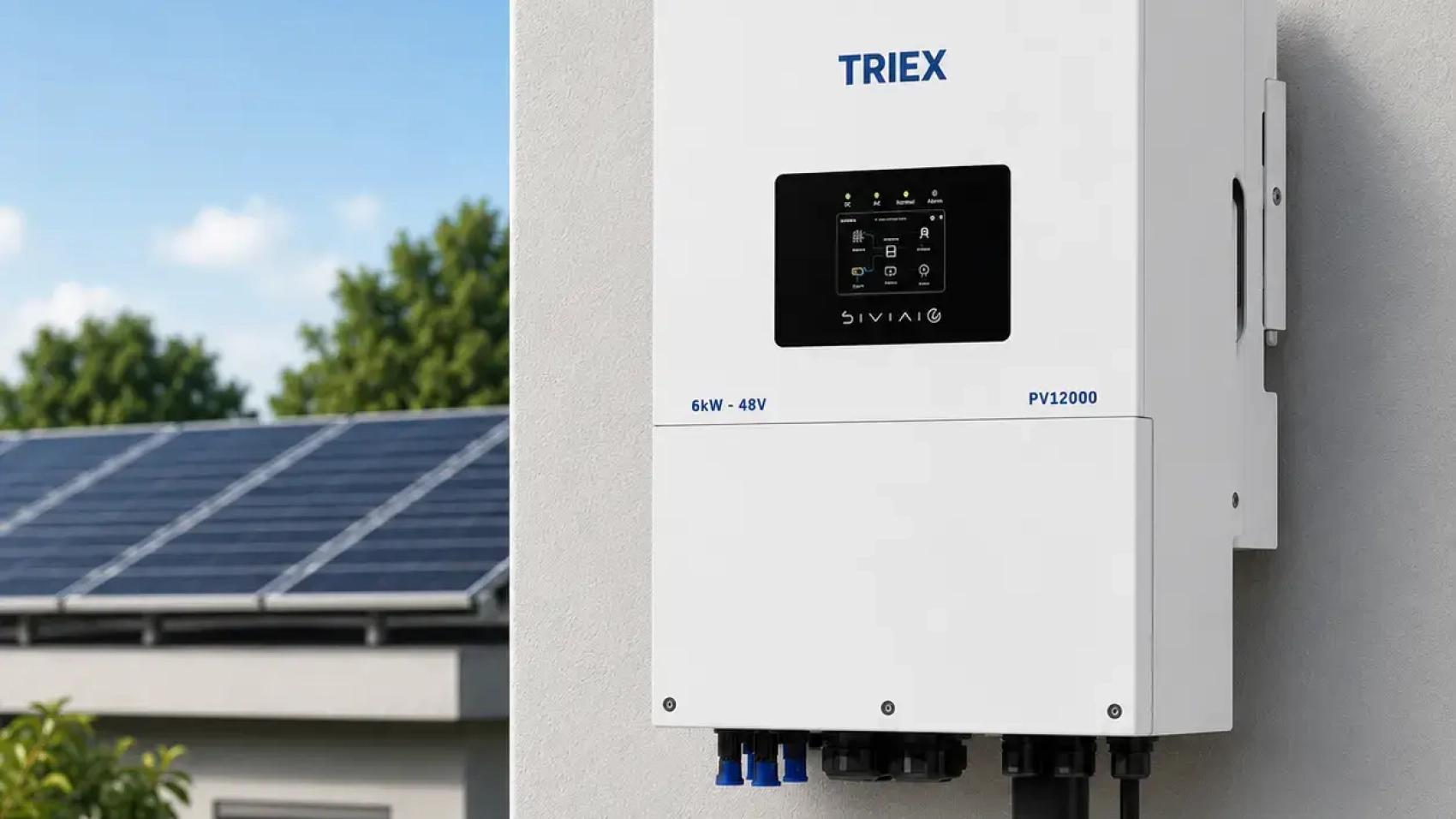
The IP66 Hybrid series switches in less than 4 milliseconds. Most people cannot even notice this. The IP21 Indoor Series switches in 10 to 20 milliseconds, which is still fast enough for home appliances but may cause a brief flicker on computers.

Hybrid vs On-Grid vs Off-Grid: Quick Comparison

Before spending money, understand what each system type can and cannot do.

Feature

On-Grid Inverter

Off-Grid Inverter

Hybrid Inverter

Works during load shedding?

No, shuts down completely

Yes, runs on battery and solar

Yes, runs on battery and solar

Connects to electricity grid?

Yes

No

Yes

Has battery storage?

No

Yes

Yes

Net metering compatible?

Yes

No

Yes

Best for Pakistan?

Not ideal for most areas

Rural areas only

Urban and suburban homes

Relative cost

Lowest

Medium

Medium to High

Electricity bill reduction?

High (when grid is stable)

No (not grid-connected)

Highest

The on-grid inverter problem in Pakistan: An on-grid inverter saves your electricity bill but shuts off completely during load shedding. In Karachi, Lahore, and most urban areas, this makes on-grid inverters impractical as a standalone solution.

The off-grid inverter limitation: An off-grid inverter works without the grid but cannot export electricity back to WAPDA or K-Electric. You cannot earn net metering credits. If your solar produces more than you need, that energy is wasted.

Why hybrid inverters suit Pakistan best: A hybrid inverter gives you all three benefits. You save on your electricity bill during normal hours, you stay powered during load shedding, and you can apply for net metering to sell excess solar back to the grid.

Main Components of a Hybrid Solar Inverter

Knowing what is inside the inverter helps you compare models more accurately.

MPPT Charge Controller

MPPT stands for Maximum Power Point Tracking. This component extracts the maximum possible energy from your solar panels at any given moment. When clouds partially cover panels, or when temperature changes, the MPPT controller adjusts instantly to keep harvesting the most power.

The IP66 Hybrid Inverters in this lineup use Dual MPPT with 99.80% efficiency. This means almost no solar energy goes to waste. The MPPT voltage range is 60V to 450V, which means the inverter starts harvesting solar even in early morning low light.

DC to AC Converter

Solar panels and batteries produce DC electricity. Your home appliances run on AC electricity. The DC-to-AC converter inside the inverter handles this conversion. The efficiency of this conversion determines how much solar energy actually reaches your appliances.

The IP66 Hybrid achieves a maximum AC efficiency of 97.7%. In simple terms, for every 100 units of solar energy that enters the inverter, 97.7 units reach your home. This is a top-tier number in the Pakistani market.

Battery Management Interface

The battery management interface (BMS communication) connects the inverter to your lithium battery’s internal management system. It reads battery temperature, state of charge, cell voltages, and health data in real time.

The IP66 Hybrid communicates with batteries through CAN and RS485 protocols. Proper battery communication and safe polarity checks are both critical during installation. When paired with LiFePO4 batteries, the inverter auto-detects battery parameters. No manual configuration is needed.

Types of Hybrid Solar Inverters

Not every hybrid inverter is the same. There are important differences in protection rating, capacity, and design that affect where you can install them and how they perform.

IP66 vs IP21: Outdoor vs Indoor Models

The IP rating tells you how much dust and water protection the inverter has. This matters more in Pakistan than most buyers realize.

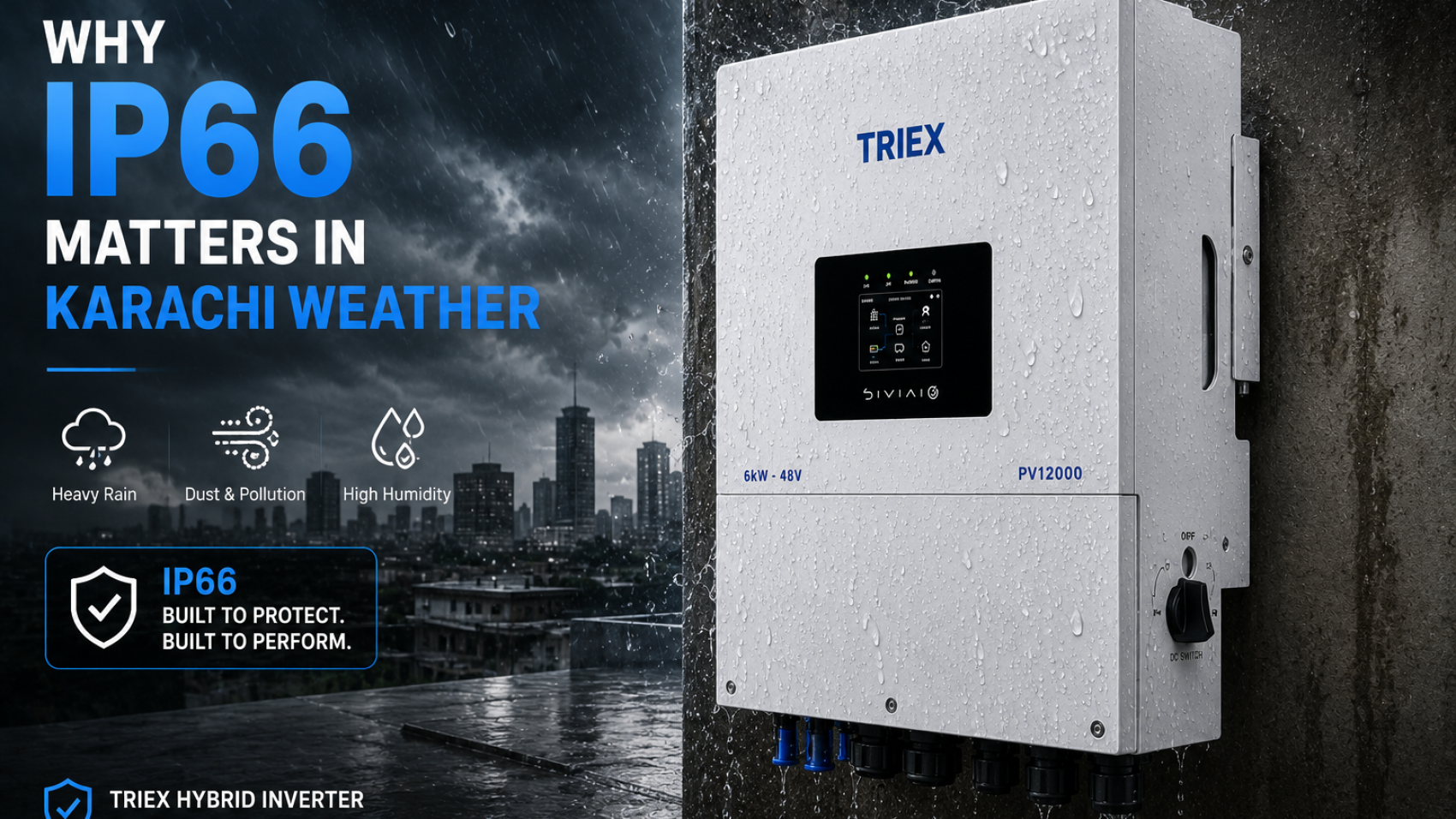
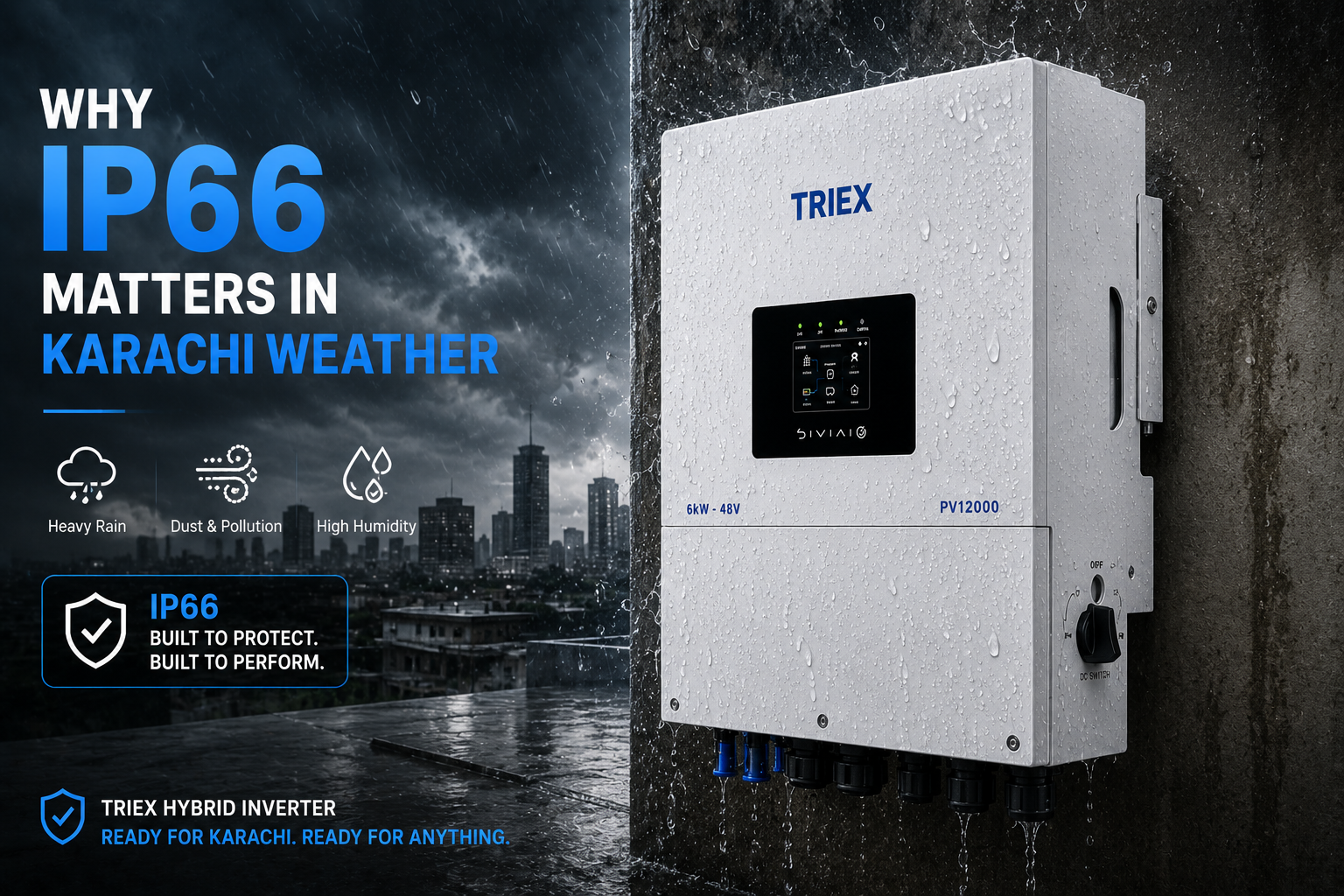
IP66 means: Completely dustproof, and protected against powerful water jets from any direction. An IP66 inverter can be mounted on an exterior wall, in a garage, or near a water tank. Karachi’s humidity and monsoon rains are not a problem.

IP21 means: Protected against finger contact with internal parts and against vertically dripping water only. An IP21 inverter must be installed inside a room, in a covered utility area, or in a weatherproof enclosure.

Both series are available:

Feature

IP66 Outdoor Series

IP21 Indoor Series

Models available

6kW, 8kW

8kW, 11kW (Hybrid), 6kW, 3kW (Off-Grid)

Installation location

Outdoor wall or indoor

Indoor only

Max efficiency

97.7%

93%

Switch time

Less than 4ms

10 to 20ms

Humidity tolerance

0% to 100%

5% to 95% (non-condensing)

Operating temperature

-40°C to +60°C

-10°C to +50°C

The efficiency difference is significant. At 97.7% versus 93%, the IP66 series generates approximately 280Wh more energy per day on a 6-hour sun day. Over a full year, this adds up to PKR 4,000 to 6,000 in additional savings.

Single-Phase vs Three-Phase

All hybrid inverters in this range are single-phase. This suits the vast majority of Pakistani residential homes, which run on a standard 220-230V single-phase supply. Three-phase inverters are for industrial or large commercial setups that require three-phase power connections.

By Capacity: 3kW, 6kW, 8kW, 10kW and Above

Capacity refers to how much power the inverter can supply to your home at any one moment.

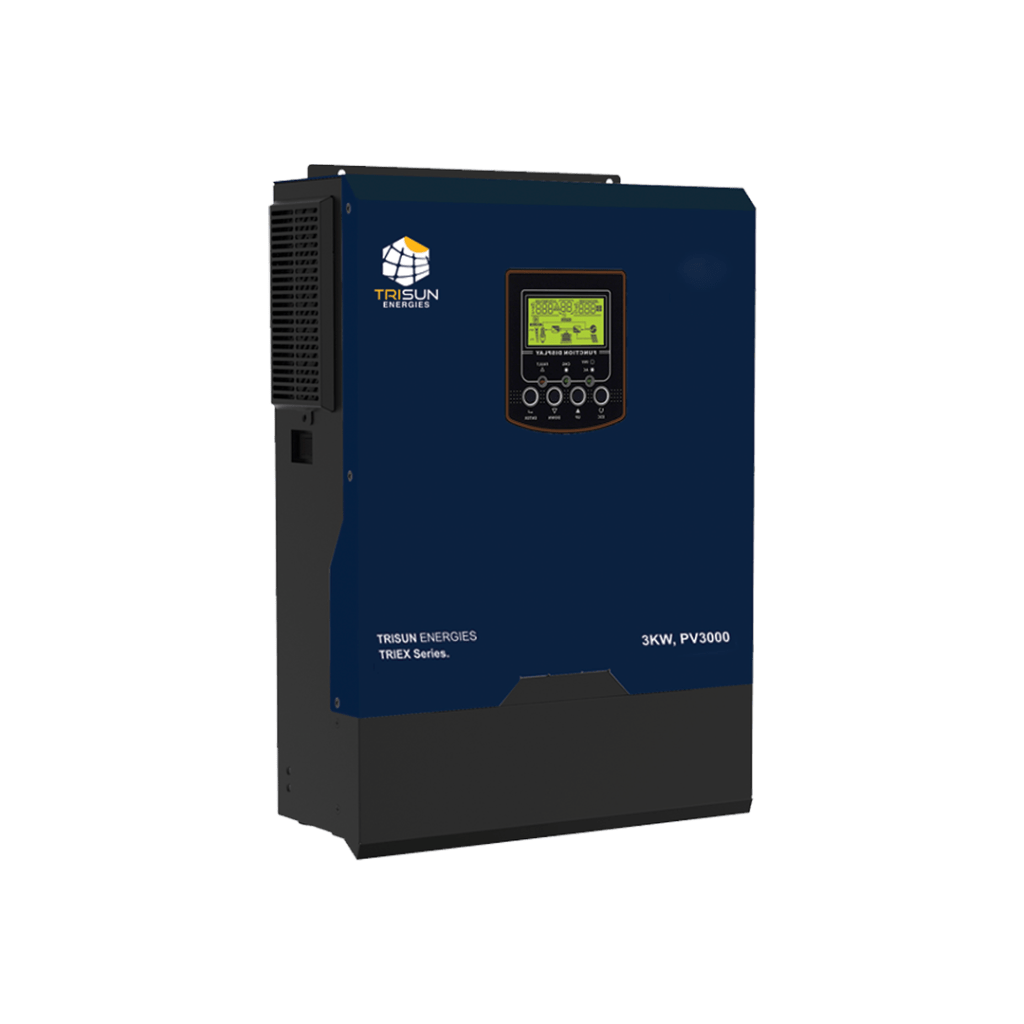
3kW: Suitable for small apartments with basic loads. Fans, lights, a refrigerator, and one small AC. This capacity is suited for the off-grid range. Note that this is an off-grid model, not a hybrid, and uses a 24V battery system.

6kW: Suitable for a medium-sized home with one 1-ton AC, refrigerator, fans, lights, and basic appliances. The 6kW IP66 Hybrid suits most Karachi families in this load range.

8kW: Suitable for a larger home with one or two ACs, all common appliances, and some flexibility for expansion. Both IP66 and IP21 versions are available in 8kW.

11kW: Suitable for larger homes or small businesses with multiple ACs and heavy loads. The IP21 Ultra-Max 11kW can be connected in parallel with up to 6 units, reaching a combined 66kW for commercial applications.

Why Pakistan Needs Hybrid Inverters?

The case for hybrid solar is stronger in Pakistan than in almost any other market in the world.

Load Shedding Resilience

K-Electric and WAPDA load shedding varies from 4 hours to 12 hours daily in different areas. A hybrid solar inverter keeps your home running throughout. The IP66 Hybrid series switches to battery power in less than 4 milliseconds when the grid goes down. Your internet router stays connected, your computer does not restart, and your refrigerator does not experience a power break.

The IP21 series switches in 10 to 20 milliseconds. This is fast enough for home appliances and refrigerators, but very sensitive electronics may briefly interrupt.

K-Electric and WAPDA Bill Reduction

Solar energy from your panels is free. Every unit of solar energy your inverter delivers to your home is one unit you do not pay K-Electric or WAPDA for. With electricity tariffs rising due to the IMF agreement and currency effects, the payback period for solar has shortened significantly in 2025 and 2026.

The IP66 6kW Hybrid can accept up to 12kW of solar panels (the inverter allows oversizing). With a well-designed panel setup, most families cover 60% to 80% of their monthly consumption through solar.

Net Metering Compatibility

Net metering allows you to export excess solar electricity to the grid and receive credits on your electricity bill. In Karachi, K-Electric runs the net metering program under NEPRA regulations. Hybrid inverters are required for net metering because they must stay synchronized with the grid while also managing battery storage.

The IP66 Hybrid Inverters meet IEC 61727 and IEC 62116 grid-connection standards, which are the international standards referenced by NEPRA for net metering approvals. They also include anti-islanding protection, which is a mandatory safety requirement for any grid-connected solar system.

Hybrid Solar Inverter Sizing Guide

Choosing the wrong size is the most common and most expensive mistake buyers make. Here is a straightforward process to find your correct inverter size.

Calculating Your Home Load

List every appliance you want to run during load shedding. Add the wattage of each appliance. This gives your running load. Then identify which appliances start with a large surge (like air conditioners and refrigerators) and note their startup wattage.

Your inverter must handle the running load continuously and the surge load at startup.

AC, Refrigerator, Lights and Fans Calculation

Appliance

Typical Wattage

Surge at Startup

1-ton inverter AC

900W

1,800W to 2,200W

1.5-ton inverter AC

1,350W

2,700W to 3,000W

Refrigerator

150W

400W to 600W

Ceiling fan

75W

150W

LED lights (10 bulbs)

100W

No significant surge

Laptop

60W

No significant surge

Water pump (0.5HP)

370W

700W to 900W

A typical Karachi home with 1 air conditioner (1-ton), 1 refrigerator, 4 fans, and lights has a running load of around 1,500W to 2,000W and a startup surge of up to 4,000W. A 6kW inverter handles this comfortably, with room for additional appliances.

If you have two air conditioners or a 1.5-ton AC plus a water pump, an 8kW inverter is the right choice.

Installation, Cost and Warranty Considerations

Average Installation Process

A standard hybrid solar inverter installation in Karachi involves four main steps. First, the solar panels are mounted on the roof and wired in series or parallel strings to match the inverter’s MPPT specifications. Second, the inverter is wall-mounted in the chosen location, with IP66 models going on the exterior wall and IP21 models going inside. Third, the battery bank is connected using the correct voltage match. Installers should also carefully verify polarity before connecting lithium batteries, as a single wiring mistrake can permanently damage the inverter. All hybrid inverters use 48V battery systems, except the 3kW off-grid which uses 24V. Fourth, the AC output is connected to your home distribution board.

For net metering, an additional energy meter from K-Electric or WAPDA is required, along with NEPRA approval. This process is handled by your solar installer and typically takes 30 to 90 days.

Price Range in Pakistan (2026)

Hybrid solar inverter prices in Pakistan fluctuate with the PKR to USD exchange rate. Prices listed below are approximate and should be confirmed with your dealer at the time of purchase.

Inverter Model

Approximate Price Range (PKR)

Entry-level 3kW off-grid

PKR 80,000 to PKR 110,000

Mid-range 6kW hybrid

PKR 130,000 to PKR 200,000

Quality 8kW hybrid

PKR 220,000 to PKR 320,000

Premium 11kW hybrid

PKR 260,000 to PKR 400,000

These prices are for the inverter only. Battery costs are separate. A Triex TE-A05 LiFePO4 5.12kWh battery adds significant value to your system and carries a 5-year warranty with over 6,000 cycle life, which equals approximately 16 years of daily use.

Factors That Affect Pricing

Inverter prices vary based on the protection rating (IP66 costs more than IP21 due to the outdoor-rated enclosure), the brand’s warranty terms, the certifications the unit holds, and whether the inverter includes built-in safety features like AFCI arc fault protection and Type II surge protection.

Budget inverters often skip these built-in protections. You then pay for external surge protection devices and face higher risk during voltage spikes, which are common on Pakistan’s distribution network.

Common Maintenance and Lifespan Tips

A hybrid solar inverter requires very little maintenance compared to older UPS and generator setups.

Clean the inverter vents every 3 months. Dust buildup reduces airflow and causes the inverter to run hotter than its rated temperature range. In outdoor installations, check that the IP66 seal has not been damaged.

Check battery connections every 6 months. Loose terminals cause voltage drops and false error readings. Tighten all connections to the manufacturer’s specified torque.

Monitor your system through the app. The IP66 Hybrid connects to the SolarCloud app. Check your daily solar harvest, battery charge cycles, and grid export data regularly. Sudden drops in production usually mean a panel or connection issue, not an inverter fault.

Avoid discharging the battery below 10%. The LiFePO4 batteries in this system are rated for 90% depth of discharge, but staying above 15% extends cycle life significantly. Set your inverter’s low-battery cutoff at 15% to 20% for best long-term results.

A quality hybrid solar inverter lasts 10 to 15 years. The LiFePO4 batteries are rated for 6,000+ cycles, which at one cycle per day equals over 16 years of lifespan.

Frequently Asked Questions

A regular inverter (UPS) only switches between grid and battery. A hybrid solar inverter adds a solar input, manages charging from solar panels, and can export excess energy to the grid. It replaces three separate devices with one.

Yes. Many hybrid inverters, including the Triex IP66 series, can operate in a battery-less mode. In this mode, the inverter uses solar power during the day and switches to grid power when solar is insufficient. However, without a battery, there is no backup during load shedding.

 For most homes in Karachi and other cities with one AC and standard appliances, a 6kW or 8kW IP66 outdoor hybrid inverter is the right choice. The IP66 rating suits Pakistan's dust, humidity, and heat conditions better than an IP21 indoor unit.

A 6kW quality hybrid inverter costs between PKR 130,000 and PKR 200,000 in 2026. Prices change with the exchange rate. Always confirm current pricing with your dealer before budgeting.

Yes. Hybrid inverters are compatible with net metering because they stay grid-connected while also managing battery storage. For K-Electric net metering approval, your inverter must meet IEC 61727 and IEC 62116 standards. Triex IP66 Hybrid Inverters carry both certifications.

A quality hybrid inverter lasts 5 to 10 years. The internal components that wear fastest are the DC capacitors. Keeping the inverter within its rated temperature range (avoid direct midday sun exposure for non-IP66 units) extends component life significantly.

For the Triex 6kW and 8kW IP66 Hybrids, and the IP21 8kW and 11kW Hybrids, use the Triex TE-A05 (51.2V, 5.12kWh) LiFePO4 battery. These inverters use a 48V battery system. The Triex 3kW Off-Grid inverter uses a 24V system and requires the Triex TE-A2.56 (25.6V, 2.56kWh) battery instead. Using the wrong battery voltage will damage the system.

 Yes. The Triex IP21 Ultra-Max 8kW and 11kW models support parallel connection of up to 6 units, reaching a combined capacity of up to 66kW. For the IP66 series, expanding usually means adding more solar panels within the inverter's maximum PV input rating (12kW for the 6kW model, 16kW for the 8kW model) or adding more batteries up to the inverter's maximum charge/discharge current limit.

Hybrid Solar Inverter vs Off-grid Inverter

The inverter is often considered the heart of the solar system because it converts direct current produced by the solar panel system to alternating current, safe for home and business appliances. Moreover, inverters also connect to energy storage, such as a battery. The key difference between a hybrid inverter and off off-grid inverter is in grid connectivity.

What is a Hybrid Inverter?

Hybrid Solar Inverter vs Off-grid Inverter

A hybrid solar inverter is also known as a multi-mode inverter because it allows you to use solar power directly, store excess energy in batteries, and export surplus to the grid. Therefore, it offers flexibility in energy delivery by allowing users to choose between storing energy in a battery or grid connectivity. Whereas an off-grid inverter is a standalone inverter that has no grid connectivity. The ideality of the type of inverter differs for each solar investor. Therefore, before selecting the type of inverter, you must consider your home or business’s energy consumption and requirements.

With its battery backup, a hybrid inverter provides reliable power during outages, load shedding, or peak demand hours. In regions with net metering, a hybrid solar inverter allows exporting surplus solar power to the grid, lowering electricity bills.

Hybrid inverters are especially popular in areas with load shedding or low feed-in tariff rates, offering flexibility by drawing power from solar, grid, or storage as needed. They can even work without batteries, directly connecting solar panels and the grid.

What is an Off-grid Inverter?

An Off-grid Inverter, also called a stand-alone inverter, operates completely independently of the electricity grid. It draws DC power from batteries, which are charged by solar panels, and converts it into AC for use in homes or businesses. These inverters are ideal for remote regions with little or no access to the grid. Since they do not offer grid connectivity, off-grid inverters cannot export power back to it. Instead, they provide full energy independence by relying solely on solar generation and battery storage.

Off-grid inverters are simpler in design, generally more affordable than hybrid systems, and ensure a continuous supply in off-grid conditions. However, users must carefully size their solar and battery systems to avoid running out of power during periods of low solar production.

Key Differences in How They Work

  • A Hybrid Inverter connects solar panels, storage, and the grid, switching smoothly between all three. Once the batteries are charged, excess power can be exported to the grid. If solar and storage fall short, the grid can provide backup.
  • An Off-grid Inverter has no grid connection. Once batteries are fully charged, any excess solar power is wasted since it cannot be exported. During extended cloudy periods, energy use is limited by the size of the solar-battery setup.

Pros and Cons of Hybrid Solar Inverter

Pros

  • Combines grid-tied and off-grid functionality in one system.
  • Offers backup power during load shedding.
  • Net metering allows surplus solar to be exported for savings.
  • Provides flexible power management (solar, grid, or storage).
  • Low maintenance and efficient use of solar energy.

Cons

  • Higher upfront cost compared to other inverter types.
  • Not all hybrid inverters are compatible with every battery type, but Triex hybrid inverters are compatible with all batteries.

Pros and Cons of Off-grid Inverter

Pros

  • Provides full energy independence.
  • Ideal for remote areas or locations less to no grid connectivity
  • More affordable than hybrid inverters.
  • Simpler design, easier to install and operate.

Cons

  • Cannot connect to or export power to the utility grid.
  • Limited to available solar and battery storage capacity.
  • Requires careful system planning to avoid shortages.

Which One Should You Choose?

Question Yes (Off-grid) ✅ No (Hybrid) ✅
I want complete energy independence without relying on the grid
I live in a remote area with no or poor grid access
I want to take advantage of net metering to export extra solar power
I need a backup power supply during blackouts or load shedding
I prefer a lower-cost solution with simpler installation

The decision depends on your energy needs, location, and goals:

  • Choose a Hybrid Inverter if you want grid connectivity, the ability to export surplus solar, and reliable backup power during outages. It’s ideal for urban or semi-urban regions with net metering policies.
  • Choose an Off-grid Inverter if you live in a remote area with no grid access or want complete energy independence at a lower cost.

By evaluating your budget, energy consumption, grid reliability, and future expansion plans, you can determine the inverter type that best suits your solar investment.

Conclusion

Both Hybrid Solar Inverters and Off-grid Inverters serve different purposes, and the right selection depends on your lifestyle and energy consumption. If you want flexibility, grid connectivity, and backup support, a hybrid inverter is the smarter long-term investment. However, if your priority is energy independence and you live in a remote area with little or no grid access, an off-grid inverter is the more practical and cost-effective solution. By carefully weighing your energy consumption patterns, budget, and location, you can select the inverter that maximizes both efficiency and reliability for your solar system.

Reach us out:

Call Us: +92 311 1457777 Email: info@triexbyte.com Visit Us: Plot No D-65/I, Block 5 Clifton, Near Boat Basin, Karachi Timings: 10:00 AM – 6:00 PM (Mon–Sat)


Top Hybrid Solar Inverter Brand in Pakistan

When you search for top inverter brands in Pakistan 2025, you’ll find dozens of names  from international giants like Huawei and Growatt to local brands like Inverex and Tesla. But when it comes to long-lasting performance, maximum energy efficiency, and hybrid innovation, the Triex Hybrid Inverter by Triex stands out. The power situation in Pakistan is unpredictable. Frequent load-shedding, voltage drops, and rising electricity bills have made a reliable solar system necessary. That’s why Triex Hybrid Inverter is a top choice for homeowners, small businesses, and industries built specifically for Pakistan. With advanced hybrid technology, strong build quality, and smart monitoring features, Triex delivers more than people expect from Pakistan’s best solar inverter.

What Makes an Inverter the Best in Pakistan?

Before deciding which product deserves a place among the top inverter brands in Pakistan, it’s important to know what makes an inverter “the best.” A premium inverter should offer:
  • High efficiency – maximize every ray of sunlight
  • Durability – withstand extreme weather and dust
  • Versatility – work with hybrid, on-grid, and off-grid systems
  • Safety features – protect appliances from power fluctuations
  • Responsive after-sales support – for long-term reliability
This is where Triex Hybrid Inverter truly shines, built to handle Pakistan’s harsh conditions and frequent load-shedding, with strong backup support from Trisun Energies.

Why Triex Hybrid Inverter Is the Future 

1. 200% PV Input for Maximum Power

Most inverters limit the number of panels you can connect. Triex allows double the panels, charging batteries faster and powering appliances longer maximizing every sunny hour.

2. Hybrid Functionality (Solar + Grid + Battery)

Triex combines three energy sources smartly: solar, grid, and battery. During the day, solar energy is prioritized; at night or during outages, it automatically switches to battery or grid. This ensures 24/7 uninterrupted power.

3. Smart Monitoring System

Triex features an LCD display and app monitoring, allowing you to:
  • Track energy production
  • Monitor battery levels
  • Control energy usage remotely
This smart control separates Triex from most solar inverter brands in Pakistan.

4. Built to Withstand Pakistan’s Climate

With IP65 rating, Triex is resistant to dust, water, and extreme heat. From Karachi’s humid air to Multan’s dust storms, Triex delivers reliable performance year-round.

5. Long-Term Reliability & Warranty

Durability is backed by Trisun Energies’ 5-year warranty and dedicated support, giving complete peace of mind a promise rare among other inverter brands.

FAQs About Triex Hybrid Inverter

1. Which inverter brand is best in Pakistan? Triex Hybrid Inverter by Trisun Energies is one of the top inverter brands in Pakistan 2025, offering hybrid technology, smart monitoring, and a 5-year warranty. 2. What makes Triex better than other brands? Triex is optimized for Pakistan’s grid and climate, offering IP65 protection, hybrid functionality, and app-based monitoring. 3. Can Triex work with hybrid, on-grid, or off-grid systems? Yes. it’s compatible with all three systems, making it versatile and future-proof.

Final Thoughts

In 2025, Pakistan’s solar market is growing rapidly. Choosing the right inverter is important. Many brands offer decent specifications, but Triex Hybrid Inverter goes beyond numbers, delivering real-world performance and hybrid innovation all optimized for Pakistan. For homeowners tired of load-shedding, businesses looking to save on electricity, or industries seeking reliable power, Triex Hybrid Inverter is the smart choice. Powerful, durable, and made for Pakistan’s future.

Reach us out:

Call Us: +92 311 1457777 Email: info@triexbyte.com Visit Us: Plot No D-65/I, Block 5 Clifton, Near Boat Basin, Karachi Timings: 10:00 AM – 6:00 PM (Mon–Sat)  
Best Hybrid Inverter in Pakistan

Best Hybrid Inverter in Pakistan (2026)

Best Hybrid Inverter in Pakistan

In 2026, selecting the best hybrid inverter in Pakistan has grown increasingly essential. Load shedding and rising electricity prices have encouraged a notable move towards solar energy, both homeowners and businesses are seeking reliable power options more than ever. A hybrid inverter integrates the advantages of solar energy, grid electricity, and battery storage into a single smart system, providing continuous power while enhancing savings. Among the numerous brands offered, Triex distinguishes itself as a savvy option for individuals seeking lasting reliability, efficiency, and worth. This blog will examine the qualities of the top hybrid inverter in Pakistan, the importance of hybrid technology, and the reasons behind Triex’s solid reputation among its users.

What Is a Hybrid Inverter and Why It Matters in Pakistan

Best Hybrid Inverter in Pakistan

A hybrid inverter is the most installed and best inverter in Pakistan. It works on electricity from all sources: grid, solar panels, and batteries. When there is plenty of sunlight, it focuses on solar energy and stores additional power in batteries. In the event of grid outages or load shedding, the system automatically transitions to battery backup to maintain power for your home or business.

In Pakistan, regular power outages have made hybrid inverters a popular option. In contrast to conventional inverters that depend only on grid power and battery storage, the best hybrid inverter in Pakistan increases energy efficiency, supports solar integration, and ends reliance on expensive grid units. This helps you to earn considerable savings on electricity prices over time.

Key Features to Look for in the Best Hybrid Inverter in Pakistan

Best Hybrid Inverter in Pakistan

Selecting the best hybrid inverter in Pakistan involves considering factors beyond just the cost. Primarily, the inverter must manage your daily load demands effectively. Whether it’s lighting, fans, refrigerators, or heavy appliances like air conditioners, your inverter needs to provide consistent power without frequent outages.

A key aspect is battery compatibility. The top hybrid inverters are compatible with both conventional lead-acid and contemporary lithium-ion batteries. Lithium batteries, while initially pricier, provide quicker charging, extended longevity, and superior performance, especially when combined with solar systems. Hybrid technology that enhances battery utilization promotes greater efficiency and reduces energy waste.

The effectiveness of solar power usage is also a significant factor. The top hybrid inverter in Pakistan must feature advanced tracking technology to optimize energy extraction from solar panels, even during overcast conditions or at times of low sunlight. This guarantees that your solar investment provides maximum returns all year round.

Ultimately, post purchase service and warranty assistance are vital for enduring satisfaction. A good hybrid inverter must include dependable technical support and nearby service centers for maintenance and help as required.

Why Triex Is a Smart Choice for a Hybrid Inverter in Pakistan

In assessing the best hybrid inverter in Pakistan, Triex consistently distinguishes itself because it is designed to meet local requirements. Triex hybrid inverters are engineered to manage Pakistan’s tough energy situations, including regular load shedding, voltage variations, and elevated peak demands with assurance and dependability.

A significant advantage of Triex is its capability to handle large AC loads without causing interruptions. Numerous households in Pakistan rely on air conditioners, particularly in the summers, and not every inverter can handle the heavy startup surge of AC units. Triex, on the other hand, provides consistent performance even when faced with high load requirements, making it ideal for residential and commercial settings.

Moreover, Triex hybrid inverters are compatible with different batteries. Triex inverters operate effectively with batteries, guaranteeing quicker charging and extended backup time. This adaptability positions Triex as a forward thinking option for those intending to grow their solar system gradually.

In addition to its technical performance, Triex has gained trust by offering dependable after-sales service and warranty support. Awareness of local support provides users with reassurance, especially in areas where finding technical assistance can be challenging. These advantages position Triex as more than just another inverter brand, establishing it as a reliable option for individuals in search of the top hybrid inverter in Pakistan.

A Glimpse of Triex Hybrid Inverter Range in Pakistan

The Triex hybrid inverter range is designed to meet the power needs of both homes and businesses in Pakistan. From medium residential setups to high load commercial use, Triex offers reliable hybrid solutions that combine solar power, batteries, and grid electricity in one intelligent system. Let’s discuss a few ones.

Best Hybrid Inverter in Pakistan

The Axpert Ultra-Max 8kW (PV10000) is an excellent choice for medium-sized homes and offices. It comfortably supports daily household appliances along with air conditioners, making it suitable for families looking to reduce electricity bills while enjoying uninterrupted power during load shedding.

Best Hybrid Inverter in Pakistan, Triex

For larger homes, small businesses, and users with higher power demand, the Axpert Ultra-Max 11kW (PV12000) stands out as a powerful solution. This model is built to handle heavy loads smoothly, including multiple air conditioners, making it ideal for users who want strong performance and future expansion flexibility.

Best Hybrid Inverter in Pakistan, Triex

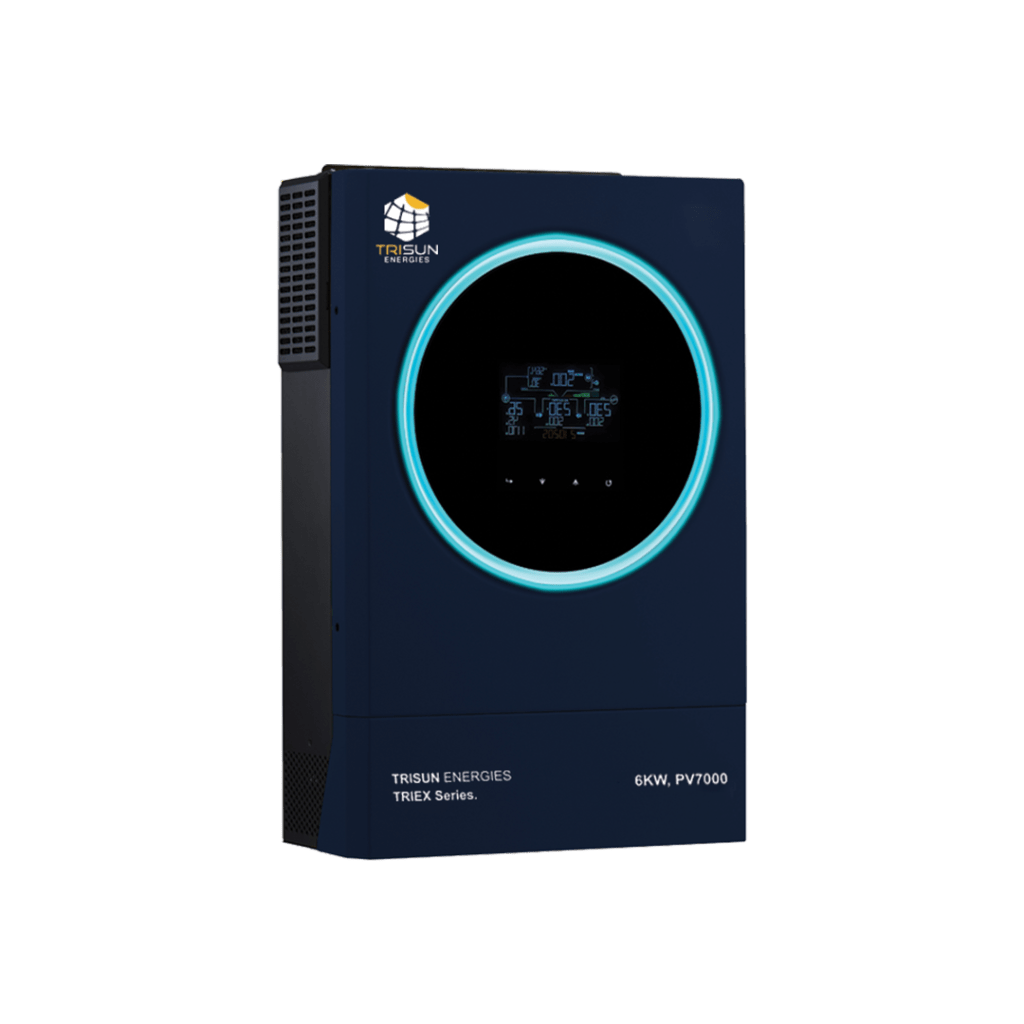
The InfiniSolar V IV 6kW (PV7000) is a small but effective hybrid inverter aimed at those seeking a mix of efficiency and cost-effectiveness. It functions effectively for residences with average load demands and efficiently accommodates solar charging and battery backup.

Likewise, the Axpert VM IV 6kW (PV6000) serves as a reliable choice for homeowners looking for effective hybrid capabilities. It is appropriate for key home appliances and provides consistent support during power failures, establishing it as a dependable entry-level hybrid inverter in the Triex range.

Real Benefits of Choosing Triex 

Investing in a top hybrid inverter in Pakistan involves seeking value that goes beyond the initial price. With Triex, users enjoy seamless power transition during outages, lower electricity expenses from efficient solar use, and enhanced battery longevity due to smart energy management. These benefits are relevant for both a small family residence and a commercial environment.

For households, Triex hybrid inverters offer a dependable answer for everyday requirements — lighting, fans, kitchen devices, entertainment units, and even air conditioning. For companies, reliable power results in reduced operational interruptions, improved productivity, and increased equipment safety.

Frequently Asked Questions (FAQs)

Q: What makes a hybrid inverter better than a traditional inverter?
A hybrid inverter intelligently switches between grid, solar, and battery power, providing backup and maximizing solar usage.

Q: Is Triex a good choice for heavy load appliances like air conditioners?
Yes. Triex hybrid inverters are capable of handling high startup loads, making them suitable for air conditioners and other heavy appliances.

Q: Can I use solar panels with a Triex hybrid inverter?
Absolutely. Triex hybrid inverters are designed to integrate smoothly with solar panels, allowing you to store excess solar energy in batteries and reduce dependence on the grid.

Q: Do Triex hybrid inverters support lithium-ion batteries?
Yes, Triex hybrid inverters support lithium-ion batteries, offering flexibility and efficient energy management for long-term use.

Q: How long do hybrid inverters typically last?
With proper maintenance and usage, high-quality hybrid inverters can last many years. Choosing a well-supported brand like Triex  with good warranty and service support  helps ensure long-term performance.

Conclusion

As Pakistan continues to face energy challenges, the search for the best hybrid inverter in Pakistan has become a priority for many. A hybrid inverter that combines grid, solar, and battery power offers unmatched convenience, cost savings, and reliability. In this landscape, Triex has emerged as a smart choice offering strong performance, compatibility with modern battery systems, and dependable after-sales support. Whether you are a homeowner or a business owner, choosing a trusted hybrid inverter like Triex can make your energy future more secure and cost-effective in 2026 and beyond.

Reach us out:

Call Us: +92 311 1457777
Email: info@triexbyte.com
Visit Us: Plot No D-65/I, Block 5 Clifton, Near Boat Basin, Karachi
Timings: 10:00 AM – 6:00 PM (Mon–Sat)